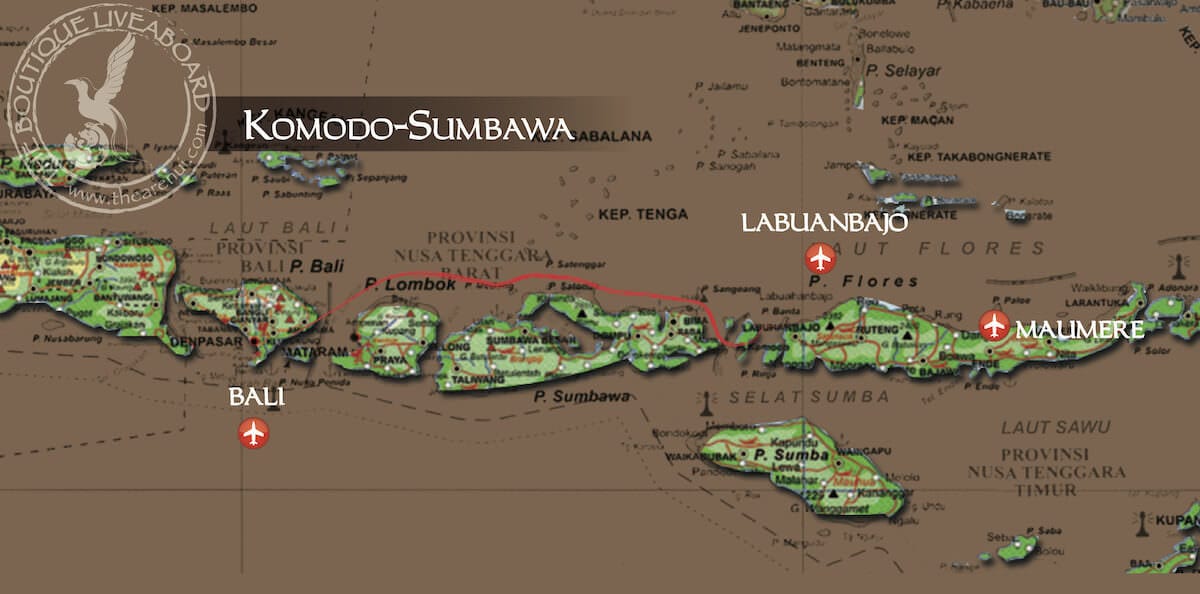
KOMODO-SUMBAWA Labuanbajo-Labuanbajo 12 Days-11 Nights

KOMODO – SUMBAWA

12 Days/11 Nights Labuanbajo – Labuanbajo Cruise Itinerary

Day 1 Embarkation in Labuanbajo

Welcome aboard Arenui! After embarkation in Labuanbajo, our Cruise Directors and crew will introduce you to the vessel, complete the safety briefing and prepare everyone for the adventure ahead.

We then begin our journey westwards across the Flores Sea towards Pulau Satonda, the first stop on an exceptional expedition combining whale sharks, volcanic islands, remarkable macro life and some of the very best coral reefs and fish action in Komodo National Park.

Day 2 Pulau Satonda (3 dives)

Satonda is a small volcanic island lying just north of Sumbawa. Above water it is famous for the remarkable crater lake hidden in its interior, while underwater its reefs, sandy slopes and scattered coral formations offer excellent opportunities for searching for Indonesia’s smaller and more unusual marine life.

We plan three dives around Satonda before beginning our long relocation towards Saleh Bay.

Lake Entrance Bay

A gentle introduction to the expedition, with a sandy slope dotted with coral bommies and patches of reef. Take your time exploring around the coral heads for leaf scorpionfish, ghost pipefish, ribbon eels, nudibranchs and other small reef inhabitants.

Sand Chute

A beautiful combination of sand, rubble and coral patches, exactly the sort of habitat where good eyes are rewarded. Look carefully amongst the corals and along the bottom for unusual macro subjects and wonderfully camouflaged critters.

Lost Boys

Our final Satonda dive continues the theme with a mixture of reef and sandy terrain offering plenty of opportunities for macro photographers and critter hunters.

After the third dive we begin our longer journey towards Saleh Bay.

Day 3 Saleh Bay (4 dives)

Today brings one of the signature encounters of the expedition: whale sharks.

Saleh Bay has become renowned for encounters with whale sharks around the traditional Indonesian fishing platforms known as bagans. These gentle giants frequently approach the platforms while fishermen work above, creating extraordinary opportunities to observe one of the largest animals in the ocean at remarkably close range.

Saleh Bay – Whale Sharks

We plan three dives in the Saleh Bay area, allowing plenty of time to enjoy these magnificent animals underwater.

Every encounter is different. A whale shark may cruise slowly alongside the divers, circle beneath a bagan or simply appear out of the blue. Spending several dives in the area gives us the opportunity to enjoy this remarkable experience without rushing it.

Sumbawa Surprise

After the spectacle of the whale sharks, the focus changes completely for our night dive.

Sumbawa Surprise is a superb critter site where dark volcanic sand provides the backdrop for some wonderfully unusual marine life. Frogfish, flamboyant cuttlefish, ghost pipefish and Rhinopias are among the special creatures that may be encountered here.

Day 4 Pulau Sangeang (4 dives)

The island of Sangeang is located northeast of Sumbawa and is dominated by Gunung Api, an active volcano. Volcanic activity has shaped both the island and its underwater environment, creating black-sand slopes, ridges, coral reefs and areas where streams of bubbles escape directly through the seabed.

Hot Rocks

Here the volcano has left its mark below the surface as well. In the shallows observe volcanic bubbles escaping from the seabed through underwater vents. Put your hands close to the sulphur-covered rocks and you may even feel the heat coming from below.

Besides the usual tropical reef species, ribbon eels, cowries and Bargibanti pygmy seahorses can also be seen here.

Lighthouse Reef

This site presents many contrasts in terms of natural features and marine life. Beautiful reef formations give way to a black-sand slope that is excellent for spotting nudibranchs and other colourful critters. Black coral bushes provide shelter for ghost pipefish and saw-blade shrimps.

Black Diamond

The rocky formations in the shallows and fingers of coral extending into deeper water are decorated with black coral and crinoids in almost every colour imaginable.

The dark volcanic sand makes the colours of the reef stand out beautifully. Ornate ghost pipefish, reef octopus, peacock mantis shrimps and nudibranchs are among the creatures regularly seen here.

Bontoh Reef

Bontoh Reef is located on the western side of Sangeang and is a wonderful site for our night dive.

A shallow area of black sand and small rocks gently slopes down into deeper water. Large populations of spaghetti garden eels emerge from the sand, while the small rocks provide hiding places for painted frogfish, juvenile angelfish, mantis shrimps and many other critters.

While exploring the open sand we may also encounter the extraordinary wunderpus or mimic octopus.

Day 5 Pulau Banta (4 dives)

Pulau Banta lies between Sumbawa and Komodo and delivers yet another change of underwater scenery.

Here beautiful coral slopes and dramatic walls meet sheltered bays rich in macro life. It is a wonderful transition between the volcanic diving of Sumbawa and the great reefs of Komodo that await us to the east.

The Canopy

A spectacular coral-covered reef populated by an impressive mixture of reef fish and larger visitors. Reef sharks, Napoleon wrasse and groupers may cruise around the reef while clouds of smaller fish bring the coral landscape to life.

Banta Wall

A dramatic drop-off covered in healthy coral growth. Keep an eye towards the blue for passing eagle rays, barracuda and other pelagic fish while exploring the beautiful reef alongside the wall.

Banta Lagoon

Inside the sheltered lagoon the emphasis switches back to the small stuff. Leaf scorpionfish, frogfish and numerous other critters hide amongst the reef, rubble and sandy patches.

Stargazer Beach

Once darkness falls we explore the sandy bottom in search of one of the strangest-looking fish in Indonesia, the stargazer.

Bobtail squid, cuttlefish and a host of nocturnal creatures can turn this into a fantastic night dive.

Day 6 North Komodo (4 dives)

We now enter Komodo National Park and begin our exploration around Gili Lawa Laut, home to some of the most celebrated dive sites in the region.

Here spectacular coral formations combine with extraordinary quantities of fish, from tiny anthias hovering above the reef to trevallies, tuna, reef sharks and other predators patrolling the blue.

Crystal Rock

The rock jutting out of the surrounding clear water explains how this site got its name, but what is truly memorable here is the extraordinary amount of marine life.

Large schools of fusiliers and anthias move above gorgeous soft corals and impressive table corals. In the blue we may see tuna, mackerel and other schooling fish, while eagle rays are occasionally spotted cruising around the reef.

Castle Rock

Castle Rock is a submerged pinnacle situated north of Crystal Rock and is famous for its spectacular concentration of fish.

Batfish, groupers, midnight snappers, fusiliers and surgeonfish gather around the reef while giant trevallies, whitetip reef sharks, blacktip reef sharks and grey reef sharks patrol nearby.

Aquarium

A wonderfully photogenic reef where beautiful coral formations can be surrounded by thousands of small fish. Look across the sandy areas for whitetip reef sharks and along the reef for hawksbill and green turtles.

Gili Lawa Darat

For our night dive we explore a protected reef around Gili Lawa Darat. Once daylight disappears a completely different community begins to emerge, giving macro enthusiasts another opportunity to search for the unusual nocturnal residents of Komodo National Park.

Day 7 North Komodo (4 dives)

A second full day in North Komodo allows us to explore another selection of beautiful reefs and enjoy the remarkable variety found in this part of the National Park.

Gili Lawa Laut Lighthouse

A long reef extends from the lighthouse at the northern end of Gili Lawa Laut. Schools of batfish, snappers and surgeonfish gather around the coral formations while Napoleon wrasse and reef sharks can appear nearby.

Coral Garden

We begin amongst white sand, beautiful coral heads and enormous barrel sponges before reaching an impressive hard-coral reef.

Look closely for leaf scorpionfish, squat lobsters and moray eels, while fusiliers, trevallies and snappers provide plenty of wide-angle action.

Batu Montjo

Situated on the northwest coast of Komodo Island, Batu Montjo is a beautiful combination of white-sand slopes, gorgonian sea fans and exceptionally pretty shallow hard-coral gardens.

Pygmy seahorses, leaf fish, jawfish and turtles are regularly seen here, and manta rays have been spotted passing by.

Batu Montjo – Night Dive

We return after sunset when the sandy slope becomes an entirely different dive.

Elusive stargazers can hide almost completely beneath the sand with only their eyes visible. Bobtail squid, ghost pipefish and other nocturnal creatures can also be found here.

Day 8 Komodo-Flores Channel (4 dives)

Today we move into Central Komodo, an area famous for spectacular reefs, colourful coral gardens, turtles and enormous numbers of reef fish.

There are many excellent dive sites in this area and the exact order of the dives will depend on the tides and the conditions on the day, allowing us to enjoy each site at its best.

Tatawa Besar

This beautiful drift dive follows the western side of Tatawa Besar through an extraordinary field of orange soft corals.

Schools of sweetlips and batfish gather around coral heads while turtles feed on the reef. Manta rays have also been encountered here.

Batu Bolong

From the surface Batu Bolong appears to be little more than a rock in the middle of the channel. Underwater it is transformed into an explosion of colour and marine life.

The rock is covered in an extraordinary amount of soft and hard corals and surrounded by fish. In the shallows watch anemonefish moving between their hosts and look for turtles feeding on the reef.

Giant trevallies, whitetip reef sharks, snappers and emperor fish regularly congregate here. Batu Bolong provides outstanding opportunities for both macro and wide-angle photography and is one of the essential dives of Komodo National Park.

Tatawa Kecil

The western side of this small rocky island presents fantastic underwater terrain with enormous slabs of rock forming channels, canyons, small caves and swim-throughs.

Crocodilefish rest on the scenic reef while schools of fusiliers and a great variety of reef fish fill the surrounding water.

Wainilo

Our night dive is situated off the north of Rinca Island.

In the shallows the hard-coral reef is home to many different critters, including juvenile harlequin sweetlips and batfish. Away from the reef, the sandy slope is scattered with soft corals hiding unusual creatures such as demon stingers, octopus and a wide variety of nocturnal marine life.

Day 9 Walk with Dragons / Central Komodo (3 dives)

Loh Buaya – Walk with Dragons

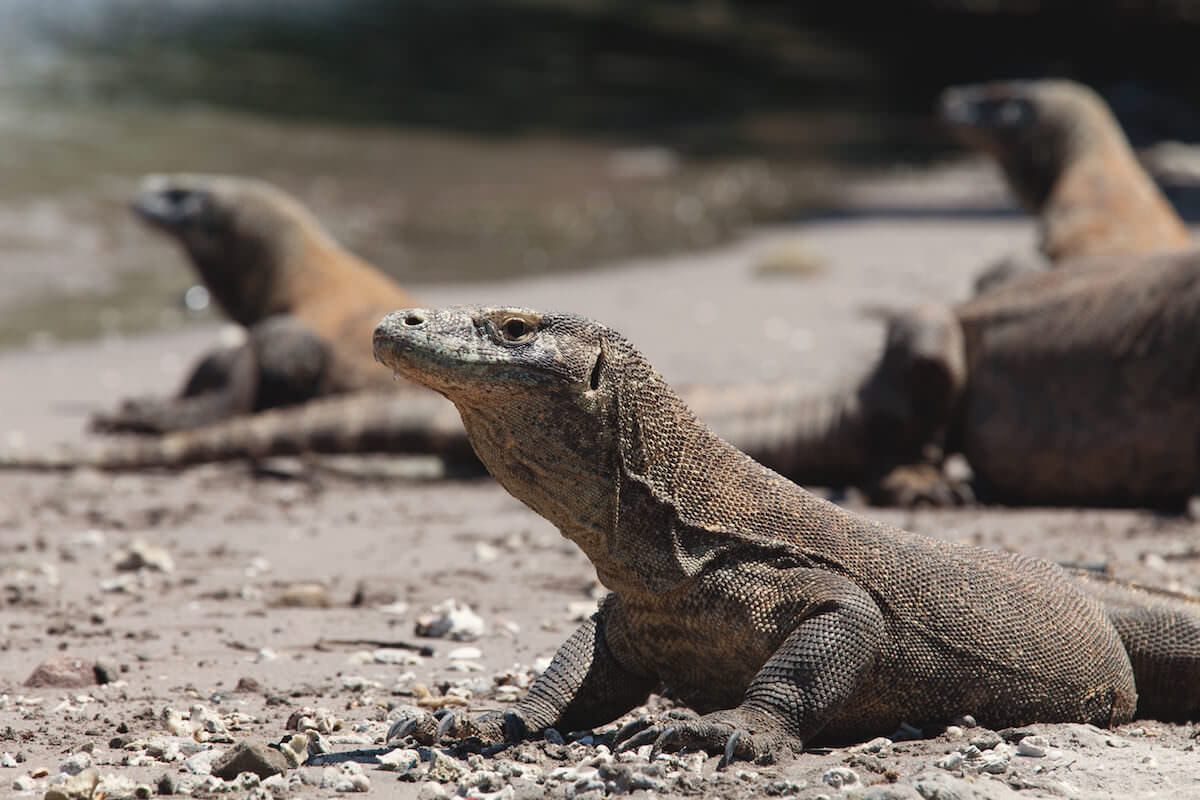
Our day begins with an exciting visit to Rinca Island in Komodo National Park, where we will have the opportunity to walk in search of the famous Komodo dragon.

Accompanied by National Park rangers, we follow the trails through the natural habitat of the world’s largest living lizard. Along the way keep an eye out for deer, wild boar and numerous species of birds in addition to the dragons.

After our walk we return to Arenui and continue our exploration of Central Komodo with three dives.

Takat Makassar

A long shallow reef interspersed with beautiful coral patches and sandy areas. Manta rays are the stars when they visit the area to feed or attend cleaning stations.

Turtles, eagle rays and reef sharks can also be encountered as we explore this distinctive reef.

Siaba Besar

White sand and healthy hard-coral formations make Siaba Besar an excellent place to search for frogfish, ghost pipefish, devil scorpionfish, leaf scorpionfish and other unusual critters.

Large green turtles are also frequent residents of the reef and are often encountered resting or feeding among the corals.

Siaba Kecil

Here we find magnificent hard-coral formations extending from the shallows down towards deeper water.

The site can be enjoyed as a beautiful drift with green and hawksbill turtles feeding amongst the coral gardens. Whitetip reef sharks may also be seen and manta rays occasionally pass alongside the reef.

Day 10 Central Komodo (4 dives)

With another complete day available in Central Komodo, we continue exploring its reefs and choose the most rewarding sites according to the tides and conditions of the day.

Sebayur Island

This island has a white sandy slope that turns into a mini wall. Look for leaf fish, ghost pipefish and a variety of nudibranchs around the edge of the reef.

Lionfish and moray eels make the wall their home, while in the shallows the hard corals are decorated with anthias. Large cuttlefish and juvenile bicolour parrotfish can also be encountered here.

Batu Tengah

Situated in the heart of Komodo National Park, Batu Tengah offers a beautiful combination of a sloping reef and a colourful coral garden.

Turtles, cuttlefish and juvenile whitetip reef sharks can often be seen amongst the hard corals. Napoleon wrasse and large groups of snappers swimming above the slope add to the spectacle.

Best of Central Komodo

For our third dive we keep the choice flexible, allowing our Cruise Directors to select one of the standout sites of Central Komodo according to the conditions and marine-life activity of the day.

This may provide an opportunity to return to a favourite such as Batu Bolong, Tatawa Besar, Takat Makassar or Siaba Kecil and experience the site under a different tidal window.

Wainilo – Night Dive

We finish the day with another opportunity to explore one of Central Komodo’s most rewarding night-diving areas and search for the remarkable smaller creatures that emerge after sunset.

Day 11 North Komodo (2 dives)

For our final diving day we return to North Komodo and finish the expedition with two of the most celebrated dive sites in the National Park.

Crystal Rock

One more opportunity to enjoy this coral-covered pinnacle, surrounded by immense schools of fusiliers and anthias with the possibility of tuna, eagle rays, trevallies and reef sharks cruising nearby.

Castle Rock

Our final dive is reserved for one of Komodo’s great underwater spectacles.

Schools of fusiliers and surgeonfish fill the water while trevallies, reef sharks, snappers and groupers patrol around the submerged pinnacle.

After the second dive we begin our leisurely journey back towards Labuanbajo. The afternoon gives everyone plenty of time to rinse equipment, relax aboard Arenui, exchange photographs and enjoy our final evening together.

Day 12 Disembarkation in Labuanbajo

After breakfast it is time to say goodbye to Arenui and our crew.

Guests disembark in Labuanbajo for transfer to the airport or their onward destination.
Total: 36 dives

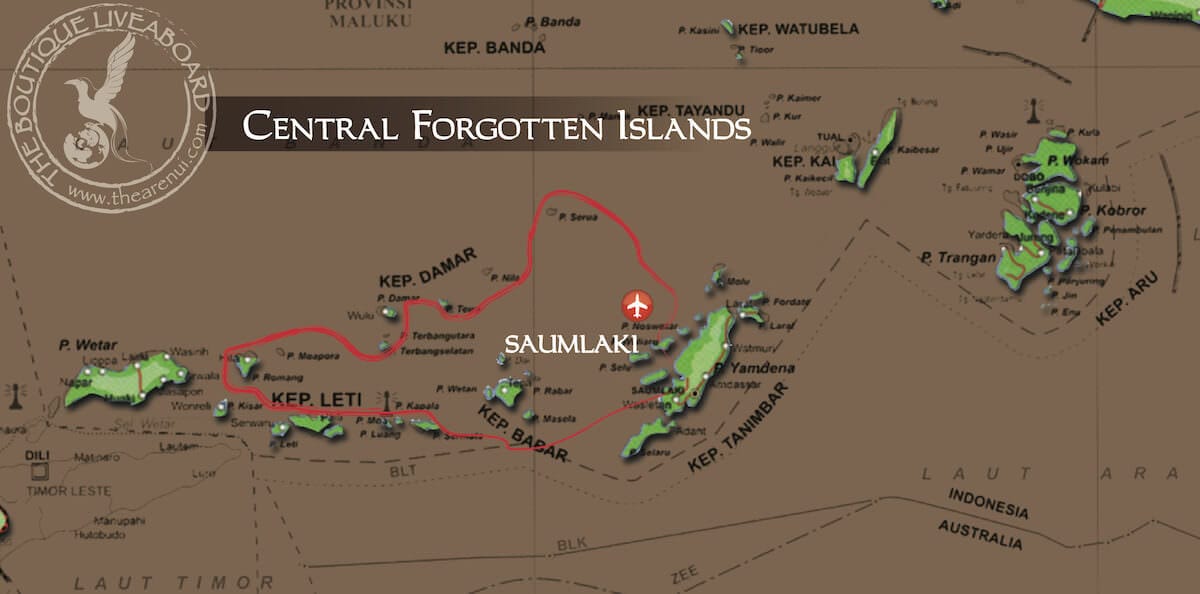
FORGOTTEN ISLANDS-HAMMERHEAD EXPEDITION Saumlaki-Saumlaki 8 days-7 Nights

FORGOTTEN ISLANDS-HAMMERHEAD EXPEDITION

8 Days/7 Nights Saumlaki – Saumlaki Cruise Itinerary

Day 1 Embarkation in Saumlaki

The Forgotten Islands are part of a remote archipelago in the southeast corner of the Moluccas (Maluku Tenggara). Despite the remote feeling in other parts of Indonesia (such as Alor or Banda), the Forgotten Islands are isolated even by Indonesian standards, covering a 1,000 km long chain of islands staring at Timor and extending up to West Papua. The Tanimbar group of around 65 islands that separate the Banda Sea from the Arafura Sea include the island of Yamdena where the capital Saumlaki is where this cruise begins.

There are many groups of islands in this area and the Forgotten Islands are relatively undiscovered and still being explored. The exact itinerary around these islands will depend exclusively on the weather and current conditions. Also due to the big distances between island groups some of the days will include three day dives before heading off in the afternoon and travelling overnight. When the next location is closer and there are anchorage spots in sheltered bays we will offer a fourth dive, usually a night dive.

Dive sites in the Forgotten Islands are characterised by endless reefs and spectacular deep walls covered in soft corals, sea fans and huge sponges. These islands usually experience amazing visibility and warm water around 27-30C (81-86F). Here are the names of the islands we may visit (weather permitting) during your cruise:

Days 2-4 Serua/Teun/Nila/Nil Desperandum (8 dives)

Teun, Nila and Serua, often referred to as TNS, are all small, very remote volcanic islands only accessible by liveaboard, located just east of Damar. You will feel as if you have reached the ends of the earth and that may be why there is a growing interest in diving in this zone. Although the sites here remain relatively unexplored, experiences so far have revealed tremendous diving potential and splendid coral reefs.

Close to the small island of Nila are two atolls Dusborgh and Nil Desperandum. Weather permitting, we will spend two days in this area, making a small bay on the east side of the island of Nila our base. There is also a night dive opportunity here.

Nila/Dusborgh (4-5 dives)

Dusborgh is a submerged atoll with a surrounding reef that reaches all the way up to the surface. The reef then slopes steeply to deep walls. As with all of the Forgotten Islands the walls are covered in huge sponges and sea fans. With the amazing visibility keep an eye into the deep for passing pelagics. A small bay on the east side of the island of Nila has a night dive opportunity.

Nil Desperandum (4-5 dives)

Nil Desperandum means “don’t despair” possibly referring to a ship wrecked here centuries ago. It is a big atoll with very deep drop offs. Schooling sharks have been spotted in the deep here with a chance to see hammerhead, silky and grey reef sharks.

Days 5 Pulau Damar/Nusleur/Terbang (4 dives)

Close to the big island of Damar the small islands of Nusleur, Terbang Utara and Terbang Selatan are surrounded by pristine beaches that stretch out to coral reefs that then drop down to the most beautiful, untouched walls. From top to bottom, the reef is an explosion of different colours and forms and seems to be in constant motion from the swarms of fish darting about. You may find yourself floating in the midst of a huge school of fish as the sea creatures here appear quite curious, perhaps because they are generally not used to seeing many divers. Another unique attraction in this area is the wall of sulphur formed as a result of its proximity to the volcano on Damar. There is a possibility to visit a village on Damar where there is also a black sand night dive.

Days 6 Dai Island (3-4 dives)

The villagers on this island still practice traditional hunting with bow and arrow. Steep slopes provide hunting grounds for schooling barracuda and trevally. Large sea fans on the reef are surrounded by very healthy reef fish life. The shallows here are full of hard corals decorated with anthias.

Days 7 Dawera Island (3-4 dives)

This small island is in the northern part of the Babar group of islands. There is a seamount where the reef is untouched and so full of fish you won’t know where to look! Along the north side of the islands there are numerous wonderful dive sites ranging from Tanjung Raja where there are stunning soft corals to Sponge Delight where there is a huge resident school of barracudas and even a chance to see hammerhead sharks. The diving in this area is so good we may even stay an extra day.

Days 8 Disembarkation in Saumlaki

Total dives: 18-20 dives

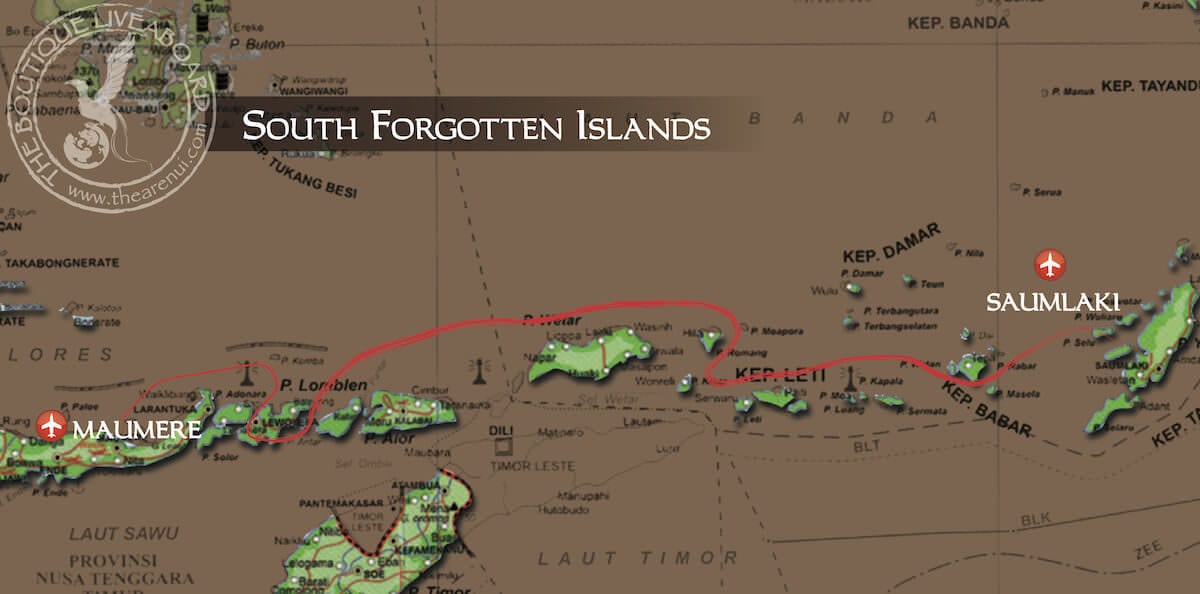
ALOR & FORGOTTEN ISLANDS Maumere-Saumlaki 12 Days-11 Nights

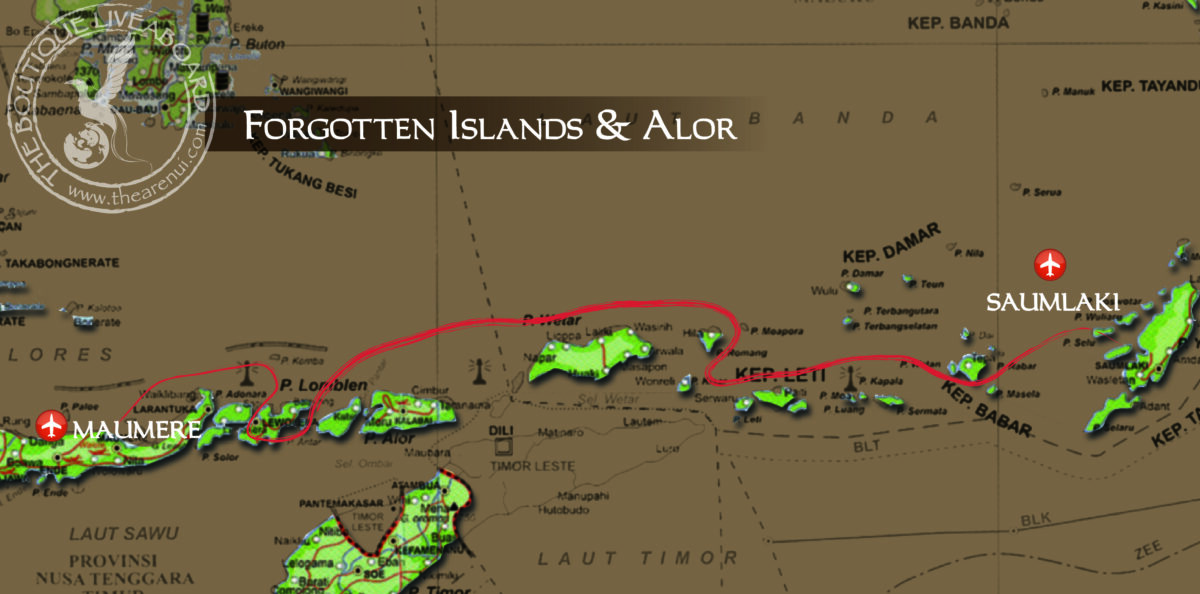
FORGOTTEN ISLANDS & ALOR

12 Days/11 Nights Saumlaki – Maumere Cruise Itinerary

Day 1 Embarkation in Saumlaki

Days 2-8 Forgotten Islands

The Forgotten Islands are part of a remote archipelago in the southeast corner of the Moluccas (Maluku Tenggara). Despite the remote feeling in other parts of Indonesia (such as Alor or Banda), the Forgotten Islands are isolated even by Indonesian standards, covering a 1,000 km long chain of islands staring at Timor and extending up to West Papua. The Tanimbar group of around 65 islands that separate the Banda Sea from the Arafura Sea include the island of Yamdena where the capital Saumlaki is where this cruise begins.

There are many groups of islands in this area and the Forgotten Islands are relatively undiscovered and still being explored. The exact itinerary around these islands will depend exclusively on the weather and current conditions. Also due to the big distances between island groups some of the days will include three day dives before heading off in the afternoon and travelling overnight. When the next location is closer and there are anchorage spots in sheltered bays we will offer a fourth dive, usually a night dive.

Dive sites in the Forgotten Islands are characterised by endless reefs and spectacular deep walls covered in soft corals, sea fans and huge sponges. These islands usually experiences amazing visibility and warm water around 27-30C (81-86F). Here are the names of the islands we may visit (weather permitting) during your cruise:

Dawera Island (4 dives)

This small island is in the northern part of the Babar group of islands. There is a seamount where the reef is untouched and so full of fish you won’t know where to look! Along the north side of the islands there are numerous wonderful dive sites ranging from Tanjung Raja where there are stunning soft corals to Sponge Delight where there is a huge resident school of barracudas and even a chance to see hammerhead sharks. The diving in this area is so good we may even stay an extra day.

Dai Island (3-4 dives)

The villagers on this island still practice traditional hunting with bow and arrow. Steep slopes provide hunting grounds for schooling barracuda and trevally. Large sea fans on the reef are surrounded by very healthy reef fish life. The shallows here are full of hard corals decorated with anthias.

Serua/Teun/Nila/Nil Desperandum

Teun, Nila and Serua, often referred to as TNS, are all small, very remote volcanic islands only accessible by liveaboard, located just east of Damar. You will feel as if you have reached the ends of the earth and that may be why there is a growing interest in diving in this zone. Although the sites here remain relatively unexplored, experiences so far have revealed tremendous diving potential and splendid coral reefs.

Close to the small island of Nila are two atolls Dusborgh and Nil Desperandum. Weather permitting we will spend two days in this area, making a small bay on the east side of the island of Nila our base. There is also a night dive opportunity here.

Nila/Dusborgh (3-4 dives)

Dusborgh is a submerged atoll with a surrounding reef that reaches all the way up to the surface. The reef then slopes steeply to deep walls. As with all of the Forgotten Islands the walls are covered in huge sponges and sea fans. With the amazing visibility keep an eye into the deep for passing pelagics. A small bay on the east side of the island of Nila has a night dive opportunity.

Nil Desperandum (3-4 dives)

Nil Desperandum means “don’t despair” possibly referring to a ship wrecked here centuries ago. It is a big atoll with very deep drop offs. Schooling sharks have been spotted in the deep here with a chance to see hammerhead, silky and grey reef sharks.

Pulau Damar/Nusleur/Terbang (4 dives)

Close to the big island of Damar the small islands of Nusleur, Terbang Utara and Terbang Selatan are surrounded by pristine beaches that stretch out to coral reefs that then drop down to the most beautiful, untouched walls. From top to bottom, the reef is an explosion of different colours and forms and seems to be in constant motion from the swarms of fish darting about. You may find yourself floating in the midst of a huge school of fish as the sea creatures here appear quite curious, perhaps because they are generally not used to seeing many divers. Another unique attraction in this area is the wall of sulphur formed as a result of its proximity to the volcano on Damar. There is a possibility to visit a village on Damar where there is also a black sand night dive.

Nyata (4 dives)

Tanjung Nyata is a wall covered in huge sponges that then turns into a deep, steep slope. On the way look out for passing large fish like tuna and trevallies. At the top of the wall is a very healthy hard coral reef where there is a resident school of snappers. At the start of the slope is a deep pinnacle where grey reef sharks circle and on the slope itself are again huge sponges and schooling fish such as barracuda, surgeon fish and fusiliers. Thousands of blue tooth triggers and pyramid butterfly fish hang out. We have even seen eagle rays pass by.

Pulau Wetar/Reong (3 dives)

Not many people can say that they have dived Wetar Island. It has several calm bays where interesting critters can be found as well as swift drift dives between Wetar and Reong that takes you past a spectacularly coloured wall.

The small island of Reong, which lies off the northwest coast of Wetar, presents a change in scenery as it is made of limestone. Reef sharks, barracuda and trevallies frequently visit these waters. Other delights can be found while diving the impressive walls and a site full of diverse marine life.

Tanjung Nunukae on Wetar Island is generally characterised by shallows forming a plateau that narrows as it goes deeper until it drops off abruptly, forming a very nice wall swathed in gigantic sea fans, cup corals and impressive sponges. Divers have come across both mobula and manta rays here. Currents are generally moderate to strong.

Day 9 Pura Island/Kalabahi Bay (4 dives)

Dives in the Alor/Pantar Strait promise a variety of thrills as the sites present a wide array of exciting possibilities, with topography ranging from dramatic shear drop-offs, spurs jutting out from the shore mingling together with shallow reefs where the light brings out the full colour of the dazzling corals covering all surfaces. The water temperature can be a little cooler in this area dropping from the normal 28/29 degrees Celsius (82-84 Fahrenheit) to a possible 20 Celsius (68 Fahrenheit).

Here you can see the famous Pura Island villagers splash out of their wooden dugout canoes diving underwater with homemade goggles made out of wood and the ends of glass bottles.
During the day we will also look out for large pelagics who use the Pantar Strait as a thoroughfare. If there are any sightings of whales, dolphins or even Mola Mola we may forego a dive and head out in the tenders with snorkelling gear to see if we can have a lucky encounter.

Yan Village

At Yan Village there are several wonderful spots to dive. Walls covered in sponges topped with shallow hard coral reefs where you can spot the elusive Mandarin fish to black sandy slopes where fans of macro will get their fill too. Some examples of the critters here are frogfish, weedy scorpionfish, all sorts of nudibranchs and yellow, blue and black ribbon eels.

Clown Valley

One exceptional dive site on Pura Island is probably the only place in the world where you will see this phenomenon. The entire reef is completely covered in anemones of all shapes and sizes. Enjoy a drift dive along this site and enjoy the abundant fish life, with thousands of colourful anthias and damsels dancing off the reef. Take a look at photos of Clown Valley and other wide-angle opportunities in Alor here.

Kalabahi Bay

Mucky Mosque and Rocky Church are two of the great muck dives we will do inside Kalabahi Bay on Alor Island. The ‘holy grail of fish’ Rhinopias can be found here, with a chance to see both the weedy and paddleflap scorpionfish. Ghost pipefish, soft coral crabs, frogfish, various octopus including the wunderpus and mimic, snake eels, sea moths, sand divers and many other remarkable creatures The only way you are likely to see stranger ones is if you do a night dive here when unimaginable ones begin foraging out of their holes.

Day 10 Visit traditional Abui tribe village/Reta Island (2 dives)

In the morning we will visit Takpala or Latevui village, both villages still living by their old Abui traditions. The villagers will perform the Lego-Lego dance wearing traditional clothing with brass anklets that make a wonderful jingling sound as they perform. Afterwards there is an opportunity to purchase handmade ikat, woven fabrics of various colours and motifs, as well as jewellery and wooden artifacts. Take a look at our photo album of these villages at Alor Abui Tribe
After the village tour we will travel out into the Alor/Pantar Strait to Reta Island where we will do two dives.

Reta Island

Reta Island has beautiful vertical walls with overhangs, undercuts and a deep plateau at 25m/75ft. It is full of hard and soft corals, barrel sponges and whip corals. At the top of the wall is a gorgeous coral garden teeming with reef fish.

Day 11 Kawula Island (4 dives)
Next to the north of Kawula Island there is a beautiful, calm bay overlooked by Lewotolo volcano. We spend the day diving here.

Tanjung Bacatan

Tanjung Bacatan is within view of Lembata and Komba volcanoes. Tanjung means corner and the dive site is situated on a point on the north shore of Kawula island. The dive site consists of a wall covered in crevices and ledges covered in soft corals and large sponges with hard coral gardens in the shallows. At one end the wall turns into a white sandy slope hosting many varieties of reef fish and triggerfish. A resident school of barracuda can be seen here as well as turtles and maybe even large trevallies passing by.

Takat Prau

In the middle of the bay there is a seamount we call Takat Prau. There is a small wooden fishing boat wrecked in the deep right next to a sea fan with pygmies. There can be schooling fusiliers here with small reef sharks patrolling the pinnacle. Leaf fish make their home in the shallows and large reef octopus are often spotted hunting in the hard coral.

Padang Pasir

This dive site has two sections. A huge expanse of white sand extends to the south and a mini wall and reef comes out from the corner of the island. In the sandy area look for waspfish, flounders, stingrays and ghost pipefish. On the wall algae shrimp, moray eels, lionfish and beautiful angelfish hide out. At the top of the reef there are healthy staghorn corals where you might spot a mandarin fish. At night the wall and reef come alive with shrimps and crabs and there is a chance you will see Spanish dancer nudis. Or hunt around in the sand for stargazers, bobtail squid and frogfish.

Day 12 Disembarkation in Maumere

Total dives: 32-36 dives