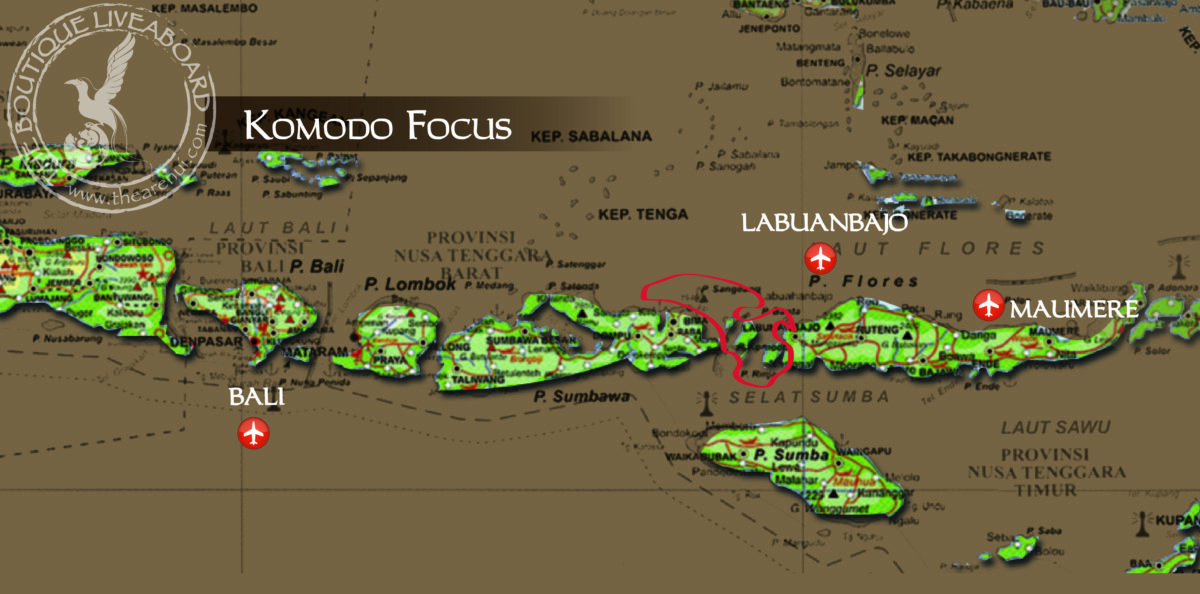
KOMODO FOCUS 11 Aug – 18 Aug 2029

KOMODO FOCUS

8 Days/7 Nights Labuanbajo – Labuanbajo Cruise Itinerary

Day 1 Embarkation in Labuanbajo

Day 2 Komodo-Flores Channel (4 dives)

Currents in this area can be quite strong and we have to dive according to the tides. There are many dive sites and the sites chosen will be dependent on the currents. Finish the day with a great night dive at Wainilo. Komodo is an excellent place for spotting macro critters and the reefs and corals are spectacular too. See some photos here.

Sebayur Kecil

This island at the east side of Komodo National Park is a perfect spot to do our check-out dive as currents tend to be very mild here. We start the dive on a white sand patch were we can look out for blue spotted stingrays, garden eels and other sand inhabitants. Continuing to the east the reef gets into a beautiful hard coral wall. Leaf scorpionfishes, reef octopus and morey eels are only a few of the inhabitants of this site.

Tatawa Besar

This is a thrilling drift dive that starts off from the northwestern tip of Tatawa and continues down the western side towards 15 to 20 meters of depth. The surrounding fish life is profuse and you will see an endless field of stunning orange soft corals as you glide along. Swim past coral heads inhabited by schools of sweetlips and batfish and look out for turtles feeding on the reef. Mantas have been encountered here as well.

Batu Bolong

Underwater this rock is covered in a huge amount of soft and hard corals and full of fish life. In the shallows watch anemone fish and look out for turtles munching on the corals. Giant trevally, white tip reef sharks, snappers and emperor fish tend to congregate here. This site presents particularly good opportunities for both macro and wide-angle photography.

Wainilo

This night dive is situated off the north of Rinca Island. In the shallows, the hard coral reef is home to many different critters, including juvenile harlequin sweetlips and batfish. Away from the reef, the sandy slope is scattered with pulsing soft corals that hide demon stingers and starry night octopus. Different types of nudibranch, frogfishes, harlequin shrimps and even wheedy rhinophias have been seen here.

Day 3 Walk with dragons/Middle Area (3 dives)

Loh Buaya (walk with dragons)

Your day will begin with an exciting visit to Komodo National Park where you will be able to take a stroll with the famous dragon! Take a look at our Komodo Dragon photo album here. As you walk along the paths, also stay on the lookout for deer, wild boar and birds in addition to the giant lizards. After the walk we move to the middle area of Komodo National Park.

Takat Makassar

This is an exhilarating drift dive along the shallow flat bottom interspersed with patches of coral reef teeming with life. There are chances to see manta rays, turtles, eagle rays and white tip and black tip reef sharks.

Siaba Besar

This spot is a nice combination with a white sand area where we can find some great critters as frogfishes, ghost pipefishes, devil scorpionfishes, upside down jellyfish and a big amount of flounders. On the hard coral area watch out for big green turtles, leaf scorpionfishes and pajama cardinalfishes.

Siaba Kecil

This little island offers a beautiful drift dive with some nice overhangs where sweetlips, snappers and trevallies can be found. After the drift we finish the dive in a pretty shallow staghorn coral area with hundreds of anthias and feeding hawksbill turtles. Have a look as well into the blue, very often we see eagle rays passing by.

Batu Tengah

This dive site is located in the middle of the Komodo National Park, 12 nautical miles to the north and 12 nautical miles to the south. The translation of Batu = Rock, Tengah = Middle. With a slope to the east of the site and a coral garden to the west Batu Tangah is a beautiful site where we often get to see turtles, cuttlefish and juvenile white tip reef sharks that hide under the table corals among the hard coral garden. Napoleon wrasse and big groups of snapper swimming on the slope with all the colourful decoration of the soft coral make Batu Tengah a high quality dive site.

Day 4 Rinca Island (4 dives)

The water temperature here and in the southern dive sites over the next few days can be a little cooler dropping from the normal 28/29 degrees Celsius (82-84 Fahrenheit) to a possible 20 Celsius (68 Fahrenheit). Also due to the infinite nutrients in the water creating the amazing biodiversity in this area the visibility can sometimes be a bit greener. Neither one of these factors can spoil the amazing diving to be had in these areas.

Horseshoe Bay is in the south of Rinca Island and we spend one full day here. Here we dive the famous Cannibal Rock, one of the top ten dives sites in the world according to some diving publications. Watch dragons, wild pigs, deer and monkeys roam the beach and take a tender ride or kayak to get a closer look.

Cannibal Rock

This outstanding dive site covers a large area with sandy slopes in the north, deep mini walls in the east, a plateau full of life in the south and rocky areas in the west. The nutrient rich bay creates the most spectacular congregation of hard and soft corals in all parts of the dive site. Sponges, ascidians, sea squirts and tube anemones are abundant. A great diversity of nudibranchs can be seen here, along with frogfish, turtles, cuttlefish and other reef fish too.

Yellow Wall of Texas

As the name suggests this wall at the southern entrance to Horseshoe Bay is covered in yellow and orange soft corals. A tiny critter, the ladybug, comes in its multitudes here. Nudibranchs decorate the wall that usually has a slight current enabling you to slowly drift along and enjoy the view.

The Boulders

Inside the bay and opposite Yellow Wall of Texas there are large rocks that continue underwater to create places for large rays to rest and even sometimes nurse sharks hide in these underwater crevices. The boulders are covered in corals becoming a paradise for marine life.

Torpedo Alley

A marvelous night dive named after the pancake sized torpedo rays that can be found here. Coconut octopus, seahorses, colorful squid and the bizarre bobbit worm all live in the black volcanic sand. A very shallow dive with a maximum depth of 10m/30ft, spend time looking for all the strange inhabitants among the rocks, soft corals and in the sand.

Day 5 Manta Alley/Pink Beach (4 dives)

Manta Alley is located on the south end of Komodo Island. After two dives looking for manta rays we head up to the middle of Komodo Island to the Pink Beach area.

Manta Alley

Manta Alley is located in Tora Langkoi Bay along the south coast of Komodo. The dive site in fact barely pierces the ocean’s surface at the end of a line of rock islets. As can be guessed from its name many manta rays are known to frequent this site and it is the most popular one in Komodo for spotting them. The area can be described as a deep gully that works as a funnel when the tide changes, causing the water to rush through at speeds of up to three to four knots with the fall and rise of the tides and up to one knot even during “slack water” periods. Watch the mantas being cleaned on the North side or enter the ‘Alley’ to see them hover effortlessly in the current.

Pink Beach

The simple topography makes this site an ideal afternoon dive. A mini wall can be found in the middle of the reef, where clouds of glassfish swarm in the cracks and crevices. An abundant amount of fish life and unusual critters make their home here, including leaf scorpionfish, crocodilefish, nudibranchs and frogfish. On one side of the wall is a sloping coral reef full of life. On the other is a sandy area with healthy staghorn corals growing and providing shelter for juvenile harlequin sweetlips and barramundi.
Loh Liang Bay
This white sand muck dive is around the corner from Pink Beach situated inside Loh Liang Bay on Komodo Island. Search for all sorts of critters here – bobtail squid, flamboyant cuttlefish, frogfish, nudibranchs, Ambon scorpion fish, cockatoo waspfish and large moray eels living in the shallow rocks.

Day 6 Noth Komodo (4 dives)

Two celebrated dive sites await you, just north of Gili Lawalaut Island. Crystal Rock and Castle Rock are both incredible locations, boasting the key elements for any impressive dive site: a wide variety of healthy corals covering the reef, plus tons of fish – both big and small and all sizes in between! There are more exhilarating dives in this area, Aquarium, Coral Garden, Gili Lawalaut Lighthouse and a bit more to the northeast Batu Montjo, along with good night dives on healthy hard coral reefs off the island of Gili Lawa Darat. Between the dives there is a chance to visit Gili Lawalaut Island and take a short trek to the top of the hill for a wonderful view over the Komodo-Flores channel.

Crystal Rock

The rock jutting out of the surrounding crystal clear waters explains how this site got its name. But what is truly memorable here are the large schools of fusiliers and anthias flitting over the gorgeous soft corals and impressive table corals. In the deep blue, you can also see at times large tuna, mackerel and other fish schooling around a small mound to the northwest. A lone eagle ray is often spotted here cruising in the currents.

Castle Rock

Castle Rock is a submerged pinnacle situated a kilometre further north from Crystal Rock. Its exposed location means strong currents but experienced divers will love the thrills to be had on this dive. In fact, the main action comes from watching the staggering amount of fish such as batfish, groupers, midnight snappers and impressive schools of fusiliers and surgeons whipping past. Of course, divers aren’t the only ones interested in the huge amount of fish here, which explains the giant trevally as well as whitetips, blacktips and grey reef sharks hunting around for their next meal.

Aquarium

This beautiful shallow dive site on the southwest corner of Gili Lawalaut offers a good possibility to see manta rays passing by. Big coral formations surrounded by thousands of glassfish offer amazing wide angle photography opportunities. White tip reef sharks can be found in the sandy bottom area and hawksbill and green turtles can be seen along the calm flower coral reef.

Coral Garden

We start the dive in a white sandy area with stunning coral heads and big barrel sponges. Watch out for leaf scorpionfishes, hairy squat lobsters, morey eels and different types of stingrays. The reef converts into a beautiful hard coral wall where thousands of fusiliers and dozens of trevallies and snappers can be seen.

Batu Montjo

In the northwest of Komodo Island, Batu Montjo is a perfect site to dive as a third dive with a amazing formation of hard corals in the shallows. Many boulders covered with gorgonian sea fans lie in between the white sandy slopes. This combination of hard corals and gorgonian sea fans with all the fish swimming in between the coral garden makes for a perfect relaxing afternoon dive. Leaf fish, mantis shrimp, jaw fish and turtles are often seen at this site.

Gili Lawalaut Lighthouse

On the north of Gili Lawalaut there is a lighthouse at the end of a long reef. When the tide is going down the dive starts on the reef with a drift to the corner. At the corner there are big schools of batfish, snappers, surgeons with napoleon wrasse and reef sharks also hanging around.

Day 7 North Komodo (1-2 dives)

On the last full day of the cruise there will be one or two dives depending on the flight times out of Labuanbajo the next day. We will spend half the day around Gili Lawalaut. After the dives we will travel back to Labuanbajo and spend the rest of the day relaxing and preparing for our famous photo contest of the trip.

Day 8 Disembarkation in Labuanbajo

Total: 20 – 21 dives
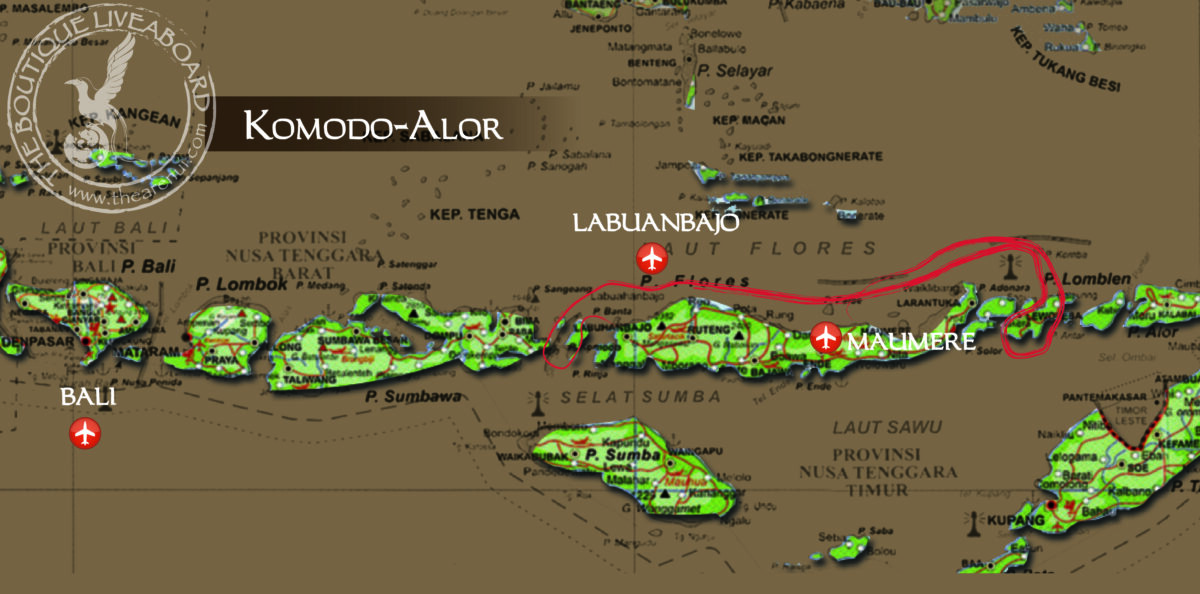
KOMODO FOCUS 02 – 09 Aug 2029

KOMODO FOCUS

8 Days/7 Nights Labuanbajo – Labuanbajo Cruise Itinerary

Day 1 Embarkation in Labuanbajo

Day 2 Komodo-Flores Channel (4 dives)

Currents in this area can be quite strong and we have to dive according to the tides. There are many dive sites and the sites chosen will be dependent on the currents. Finish the day with a great night dive at Wainilo. Komodo is an excellent place for spotting macro critters and the reefs and corals are spectacular too. See some photos here.

Sebayur Kecil

This island at the east side of Komodo National Park is a perfect spot to do our check-out dive as currents tend to be very mild here. We start the dive on a white sand patch were we can look out for blue spotted stingrays, garden eels and other sand inhabitants. Continuing to the east the reef gets into a beautiful hard coral wall. Leaf scorpionfishes, reef octopus and morey eels are only a few of the inhabitants of this site.

Tatawa Besar

This is a thrilling drift dive that starts off from the northwestern tip of Tatawa and continues down the western side towards 15 to 20 meters of depth. The surrounding fish life is profuse and you will see an endless field of stunning orange soft corals as you glide along. Swim past coral heads inhabited by schools of sweetlips and batfish and look out for turtles feeding on the reef. Mantas have been encountered here as well.

Batu Bolong

Underwater this rock is covered in a huge amount of soft and hard corals and full of fish life. In the shallows watch anemone fish and look out for turtles munching on the corals. Giant trevally, white tip reef sharks, snappers and emperor fish tend to congregate here. This site presents particularly good opportunities for both macro and wide-angle photography.

Wainilo

This night dive is situated off the north of Rinca Island. In the shallows, the hard coral reef is home to many different critters, including juvenile harlequin sweetlips and batfish. Away from the reef, the sandy slope is scattered with pulsing soft corals that hide demon stingers and starry night octopus. Different types of nudibranch, frogfishes, harlequin shrimps and even wheedy rhinophias have been seen here.

Day 3 Walk with dragons/Middle Area (3 dives)

Loh Buaya (walk with dragons)

Your day will begin with an exciting visit to Komodo National Park where you will be able to take a stroll with the famous dragon! Take a look at our Komodo Dragon photo album here. As you walk along the paths, also stay on the lookout for deer, wild boar and birds in addition to the giant lizards. After the walk we move to the middle area of Komodo National Park.

Takat Makassar

This is an exhilarating drift dive along the shallow flat bottom interspersed with patches of coral reef teeming with life. There are chances to see manta rays, turtles, eagle rays and white tip and black tip reef sharks.

Siaba Besar

This spot is a nice combination with a white sand area where we can find some great critters as frogfishes, ghost pipefishes, devil scorpionfishes, upside down jellyfish and a big amount of flounders. On the hard coral area watch out for big green turtles, leaf scorpionfishes and pajama cardinalfishes.

Siaba Kecil

This little island offers a beautiful drift dive with some nice overhangs where sweetlips, snappers and trevallies can be found. After the drift we finish the dive in a pretty shallow staghorn coral area with hundreds of anthias and feeding hawksbill turtles. Have a look as well into the blue, very often we see eagle rays passing by.

Batu Tengah

This dive site is located in the middle of the Komodo National Park, 12 nautical miles to the north and 12 nautical miles to the south. The translation of Batu = Rock, Tengah = Middle. With a slope to the east of the site and a coral garden to the west Batu Tangah is a beautiful site where we often get to see turtles, cuttlefish and juvenile white tip reef sharks that hide under the table corals among the hard coral garden. Napoleon wrasse and big groups of snapper swimming on the slope with all the colourful decoration of the soft coral make Batu Tengah a high quality dive site.

Day 4 Rinca Island (4 dives)

The water temperature here and in the southern dive sites over the next few days can be a little cooler dropping from the normal 28/29 degrees Celsius (82-84 Fahrenheit) to a possible 20 Celsius (68 Fahrenheit). Also due to the infinite nutrients in the water creating the amazing biodiversity in this area the visibility can sometimes be a bit greener. Neither one of these factors can spoil the amazing diving to be had in these areas.

Horseshoe Bay is in the south of Rinca Island and we spend one full day here. Here we dive the famous Cannibal Rock, one of the top ten dives sites in the world according to some diving publications. Watch dragons, wild pigs, deer and monkeys roam the beach and take a tender ride or kayak to get a closer look.

Cannibal Rock

This outstanding dive site covers a large area with sandy slopes in the north, deep mini walls in the east, a plateau full of life in the south and rocky areas in the west. The nutrient rich bay creates the most spectacular congregation of hard and soft corals in all parts of the dive site. Sponges, ascidians, sea squirts and tube anemones are abundant. A great diversity of nudibranchs can be seen here, along with frogfish, turtles, cuttlefish and other reef fish too.

Yellow Wall of Texas

As the name suggests this wall at the southern entrance to Horseshoe Bay is covered in yellow and orange soft corals. A tiny critter, the ladybug, comes in its multitudes here. Nudibranchs decorate the wall that usually has a slight current enabling you to slowly drift along and enjoy the view.

The Boulders

Inside the bay and opposite Yellow Wall of Texas there are large rocks that continue underwater to create places for large rays to rest and even sometimes nurse sharks hide in these underwater crevices. The boulders are covered in corals becoming a paradise for marine life.

Torpedo Alley

A marvelous night dive named after the pancake sized torpedo rays that can be found here. Coconut octopus, seahorses, colorful squid and the bizarre bobbit worm all live in the black volcanic sand. A very shallow dive with a maximum depth of 10m/30ft, spend time looking for all the strange inhabitants among the rocks, soft corals and in the sand.

Day 5 Manta Alley/Pink Beach (4 dives)

Manta Alley is located on the south end of Komodo Island. After two dives looking for manta rays we head up to the middle of Komodo Island to the Pink Beach area.

Manta Alley

Manta Alley is located in Tora Langkoi Bay along the south coast of Komodo. The dive site in fact barely pierces the ocean’s surface at the end of a line of rock islets. As can be guessed from its name many manta rays are known to frequent this site and it is the most popular one in Komodo for spotting them. The area can be described as a deep gully that works as a funnel when the tide changes, causing the water to rush through at speeds of up to three to four knots with the fall and rise of the tides and up to one knot even during “slack water” periods. Watch the mantas being cleaned on the North side or enter the ‘Alley’ to see them hover effortlessly in the current.

Pink Beach

The simple topography makes this site an ideal afternoon dive. A mini wall can be found in the middle of the reef, where clouds of glassfish swarm in the cracks and crevices. An abundant amount of fish life and unusual critters make their home here, including leaf scorpionfish, crocodilefish, nudibranchs and frogfish. On one side of the wall is a sloping coral reef full of life. On the other is a sandy area with healthy staghorn corals growing and providing shelter for juvenile harlequin sweetlips and barramundi.
Loh Liang Bay
This white sand muck dive is around the corner from Pink Beach situated inside Loh Liang Bay on Komodo Island. Search for all sorts of critters here – bobtail squid, flamboyant cuttlefish, frogfish, nudibranchs, Ambon scorpion fish, cockatoo waspfish and large moray eels living in the shallow rocks.

Day 6 Noth Komodo (4 dives)

Two celebrated dive sites await you, just north of Gili Lawalaut Island. Crystal Rock and Castle Rock are both incredible locations, boasting the key elements for any impressive dive site: a wide variety of healthy corals covering the reef, plus tons of fish – both big and small and all sizes in between! There are more exhilarating dives in this area, Aquarium, Coral Garden, Gili Lawalaut Lighthouse and a bit more to the northeast Batu Montjo, along with good night dives on healthy hard coral reefs off the island of Gili Lawa Darat. Between the dives there is a chance to visit Gili Lawalaut Island and take a short trek to the top of the hill for a wonderful view over the Komodo-Flores channel.

Crystal Rock

The rock jutting out of the surrounding crystal clear waters explains how this site got its name. But what is truly memorable here are the large schools of fusiliers and anthias flitting over the gorgeous soft corals and impressive table corals. In the deep blue, you can also see at times large tuna, mackerel and other fish schooling around a small mound to the northwest. A lone eagle ray is often spotted here cruising in the currents.

Castle Rock

Castle Rock is a submerged pinnacle situated a kilometre further north from Crystal Rock. Its exposed location means strong currents but experienced divers will love the thrills to be had on this dive. In fact, the main action comes from watching the staggering amount of fish such as batfish, groupers, midnight snappers and impressive schools of fusiliers and surgeons whipping past. Of course, divers aren’t the only ones interested in the huge amount of fish here, which explains the giant trevally as well as whitetips, blacktips and grey reef sharks hunting around for their next meal.

Aquarium

This beautiful shallow dive site on the southwest corner of Gili Lawalaut offers a good possibility to see manta rays passing by. Big coral formations surrounded by thousands of glassfish offer amazing wide angle photography opportunities. White tip reef sharks can be found in the sandy bottom area and hawksbill and green turtles can be seen along the calm flower coral reef.

Coral Garden

We start the dive in a white sandy area with stunning coral heads and big barrel sponges. Watch out for leaf scorpionfishes, hairy squat lobsters, morey eels and different types of stingrays. The reef converts into a beautiful hard coral wall where thousands of fusiliers and dozens of trevallies and snappers can be seen.

Batu Montjo

In the northwest of Komodo Island, Batu Montjo is a perfect site to dive as a third dive with a amazing formation of hard corals in the shallows. Many boulders covered with gorgonian sea fans lie in between the white sandy slopes. This combination of hard corals and gorgonian sea fans with all the fish swimming in between the coral garden makes for a perfect relaxing afternoon dive. Leaf fish, mantis shrimp, jaw fish and turtles are often seen at this site.

Gili Lawalaut Lighthouse

On the north of Gili Lawalaut there is a lighthouse at the end of a long reef. When the tide is going down the dive starts on the reef with a drift to the corner. At the corner there are big schools of batfish, snappers, surgeons with napoleon wrasse and reef sharks also hanging around.

Day 7 North Komodo (1-2 dives)

On the last full day of the cruise there will be one or two dives depending on the flight times out of Labuanbajo the next day. We will spend half the day around Gili Lawalaut. After the dives we will travel back to Labuanbajo and spend the rest of the day relaxing and preparing for our famous photo contest of the trip.

Day 8 Disembarkation in Labuanbajo

Total: 20 – 21 dives
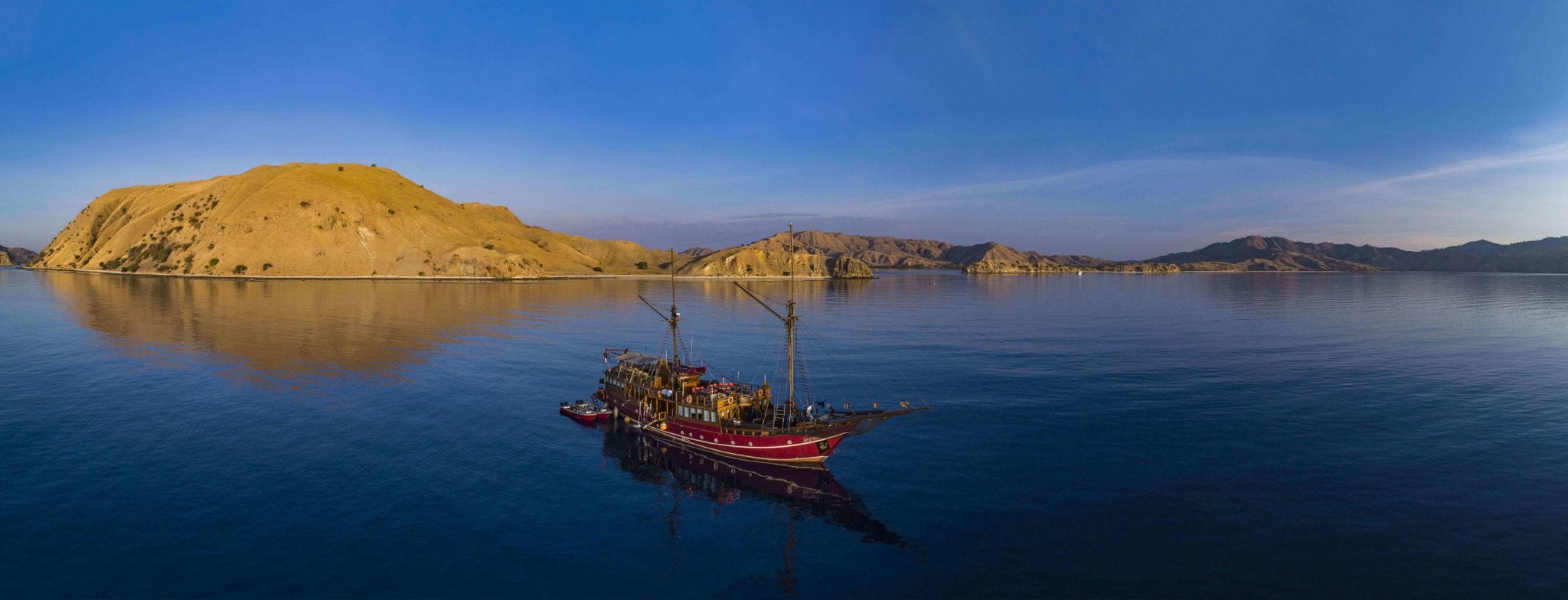
KOMODO FOCUS 24 Jul – 31 Jul 2029

KOMODO FOCUS

8 Days/7 Nights Labuanbajo – Labuanbajo Cruise Itinerary

Day 1 Embarkation in Labuanbajo

Day 2 Komodo-Flores Channel (4 dives)

Currents in this area can be quite strong and we have to dive according to the tides. There are many dive sites and the sites chosen will be dependent on the currents. Finish the day with a great night dive at Wainilo. Komodo is an excellent place for spotting macro critters and the reefs and corals are spectacular too. See some photos here.

Sebayur Kecil

This island at the east side of Komodo National Park is a perfect spot to do our check-out dive as currents tend to be very mild here. We start the dive on a white sand patch were we can look out for blue spotted stingrays, garden eels and other sand inhabitants. Continuing to the east the reef gets into a beautiful hard coral wall. Leaf scorpionfishes, reef octopus and morey eels are only a few of the inhabitants of this site.

Tatawa Besar

This is a thrilling drift dive that starts off from the northwestern tip of Tatawa and continues down the western side towards 15 to 20 meters of depth. The surrounding fish life is profuse and you will see an endless field of stunning orange soft corals as you glide along. Swim past coral heads inhabited by schools of sweetlips and batfish and look out for turtles feeding on the reef. Mantas have been encountered here as well.

Batu Bolong

Underwater this rock is covered in a huge amount of soft and hard corals and full of fish life. In the shallows watch anemone fish and look out for turtles munching on the corals. Giant trevally, white tip reef sharks, snappers and emperor fish tend to congregate here. This site presents particularly good opportunities for both macro and wide-angle photography.

Wainilo

This night dive is situated off the north of Rinca Island. In the shallows, the hard coral reef is home to many different critters, including juvenile harlequin sweetlips and batfish. Away from the reef, the sandy slope is scattered with pulsing soft corals that hide demon stingers and starry night octopus. Different types of nudibranch, frogfishes, harlequin shrimps and even wheedy rhinophias have been seen here.

Day 3 Walk with dragons/Middle Area (3 dives)

Loh Buaya (walk with dragons)

Your day will begin with an exciting visit to Komodo National Park where you will be able to take a stroll with the famous dragon! Take a look at our Komodo Dragon photo album here. As you walk along the paths, also stay on the lookout for deer, wild boar and birds in addition to the giant lizards. After the walk we move to the middle area of Komodo National Park.

Takat Makassar

This is an exhilarating drift dive along the shallow flat bottom interspersed with patches of coral reef teeming with life. There are chances to see manta rays, turtles, eagle rays and white tip and black tip reef sharks.

Siaba Besar

This spot is a nice combination with a white sand area where we can find some great critters as frogfishes, ghost pipefishes, devil scorpionfishes, upside down jellyfish and a big amount of flounders. On the hard coral area watch out for big green turtles, leaf scorpionfishes and pajama cardinalfishes.

Siaba Kecil

This little island offers a beautiful drift dive with some nice overhangs where sweetlips, snappers and trevallies can be found. After the drift we finish the dive in a pretty shallow staghorn coral area with hundreds of anthias and feeding hawksbill turtles. Have a look as well into the blue, very often we see eagle rays passing by.

Batu Tengah

This dive site is located in the middle of the Komodo National Park, 12 nautical miles to the north and 12 nautical miles to the south. The translation of Batu = Rock, Tengah = Middle. With a slope to the east of the site and a coral garden to the west Batu Tangah is a beautiful site where we often get to see turtles, cuttlefish and juvenile white tip reef sharks that hide under the table corals among the hard coral garden. Napoleon wrasse and big groups of snapper swimming on the slope with all the colourful decoration of the soft coral make Batu Tengah a high quality dive site.

Day 4 Rinca Island (4 dives)

The water temperature here and in the southern dive sites over the next few days can be a little cooler dropping from the normal 28/29 degrees Celsius (82-84 Fahrenheit) to a possible 20 Celsius (68 Fahrenheit). Also due to the infinite nutrients in the water creating the amazing biodiversity in this area the visibility can sometimes be a bit greener. Neither one of these factors can spoil the amazing diving to be had in these areas.

Horseshoe Bay is in the south of Rinca Island and we spend one full day here. Here we dive the famous Cannibal Rock, one of the top ten dives sites in the world according to some diving publications. Watch dragons, wild pigs, deer and monkeys roam the beach and take a tender ride or kayak to get a closer look.

Cannibal Rock

This outstanding dive site covers a large area with sandy slopes in the north, deep mini walls in the east, a plateau full of life in the south and rocky areas in the west. The nutrient rich bay creates the most spectacular congregation of hard and soft corals in all parts of the dive site. Sponges, ascidians, sea squirts and tube anemones are abundant. A great diversity of nudibranchs can be seen here, along with frogfish, turtles, cuttlefish and other reef fish too.

Yellow Wall of Texas

As the name suggests this wall at the southern entrance to Horseshoe Bay is covered in yellow and orange soft corals. A tiny critter, the ladybug, comes in its multitudes here. Nudibranchs decorate the wall that usually has a slight current enabling you to slowly drift along and enjoy the view.

The Boulders

Inside the bay and opposite Yellow Wall of Texas there are large rocks that continue underwater to create places for large rays to rest and even sometimes nurse sharks hide in these underwater crevices. The boulders are covered in corals becoming a paradise for marine life.

Torpedo Alley

A marvelous night dive named after the pancake sized torpedo rays that can be found here. Coconut octopus, seahorses, colorful squid and the bizarre bobbit worm all live in the black volcanic sand. A very shallow dive with a maximum depth of 10m/30ft, spend time looking for all the strange inhabitants among the rocks, soft corals and in the sand.

Day 5 Manta Alley/Pink Beach (4 dives)

Manta Alley is located on the south end of Komodo Island. After two dives looking for manta rays we head up to the middle of Komodo Island to the Pink Beach area.

Manta Alley

Manta Alley is located in Tora Langkoi Bay along the south coast of Komodo. The dive site in fact barely pierces the ocean’s surface at the end of a line of rock islets. As can be guessed from its name many manta rays are known to frequent this site and it is the most popular one in Komodo for spotting them. The area can be described as a deep gully that works as a funnel when the tide changes, causing the water to rush through at speeds of up to three to four knots with the fall and rise of the tides and up to one knot even during “slack water” periods. Watch the mantas being cleaned on the North side or enter the ‘Alley’ to see them hover effortlessly in the current.

Pink Beach

The simple topography makes this site an ideal afternoon dive. A mini wall can be found in the middle of the reef, where clouds of glassfish swarm in the cracks and crevices. An abundant amount of fish life and unusual critters make their home here, including leaf scorpionfish, crocodilefish, nudibranchs and frogfish. On one side of the wall is a sloping coral reef full of life. On the other is a sandy area with healthy staghorn corals growing and providing shelter for juvenile harlequin sweetlips and barramundi.
Loh Liang Bay
This white sand muck dive is around the corner from Pink Beach situated inside Loh Liang Bay on Komodo Island. Search for all sorts of critters here – bobtail squid, flamboyant cuttlefish, frogfish, nudibranchs, Ambon scorpion fish, cockatoo waspfish and large moray eels living in the shallow rocks.

Day 6 Noth Komodo (4 dives)

Two celebrated dive sites await you, just north of Gili Lawalaut Island. Crystal Rock and Castle Rock are both incredible locations, boasting the key elements for any impressive dive site: a wide variety of healthy corals covering the reef, plus tons of fish – both big and small and all sizes in between! There are more exhilarating dives in this area, Aquarium, Coral Garden, Gili Lawalaut Lighthouse and a bit more to the northeast Batu Montjo, along with good night dives on healthy hard coral reefs off the island of Gili Lawa Darat. Between the dives there is a chance to visit Gili Lawalaut Island and take a short trek to the top of the hill for a wonderful view over the Komodo-Flores channel.

Crystal Rock

The rock jutting out of the surrounding crystal clear waters explains how this site got its name. But what is truly memorable here are the large schools of fusiliers and anthias flitting over the gorgeous soft corals and impressive table corals. In the deep blue, you can also see at times large tuna, mackerel and other fish schooling around a small mound to the northwest. A lone eagle ray is often spotted here cruising in the currents.

Castle Rock

Castle Rock is a submerged pinnacle situated a kilometre further north from Crystal Rock. Its exposed location means strong currents but experienced divers will love the thrills to be had on this dive. In fact, the main action comes from watching the staggering amount of fish such as batfish, groupers, midnight snappers and impressive schools of fusiliers and surgeons whipping past. Of course, divers aren’t the only ones interested in the huge amount of fish here, which explains the giant trevally as well as whitetips, blacktips and grey reef sharks hunting around for their next meal.

Aquarium

This beautiful shallow dive site on the southwest corner of Gili Lawalaut offers a good possibility to see manta rays passing by. Big coral formations surrounded by thousands of glassfish offer amazing wide angle photography opportunities. White tip reef sharks can be found in the sandy bottom area and hawksbill and green turtles can be seen along the calm flower coral reef.

Coral Garden

We start the dive in a white sandy area with stunning coral heads and big barrel sponges. Watch out for leaf scorpionfishes, hairy squat lobsters, morey eels and different types of stingrays. The reef converts into a beautiful hard coral wall where thousands of fusiliers and dozens of trevallies and snappers can be seen.

Batu Montjo

In the northwest of Komodo Island, Batu Montjo is a perfect site to dive as a third dive with a amazing formation of hard corals in the shallows. Many boulders covered with gorgonian sea fans lie in between the white sandy slopes. This combination of hard corals and gorgonian sea fans with all the fish swimming in between the coral garden makes for a perfect relaxing afternoon dive. Leaf fish, mantis shrimp, jaw fish and turtles are often seen at this site.

Gili Lawalaut Lighthouse

On the north of Gili Lawalaut there is a lighthouse at the end of a long reef. When the tide is going down the dive starts on the reef with a drift to the corner. At the corner there are big schools of batfish, snappers, surgeons with napoleon wrasse and reef sharks also hanging around.

Day 7 North Komodo (1-2 dives)

On the last full day of the cruise there will be one or two dives depending on the flight times out of Labuanbajo the next day. We will spend half the day around Gili Lawalaut. After the dives we will travel back to Labuanbajo and spend the rest of the day relaxing and preparing for our famous photo contest of the trip.

Day 8 Disembarkation in Labuanbajo

Total: 20 – 21 dives
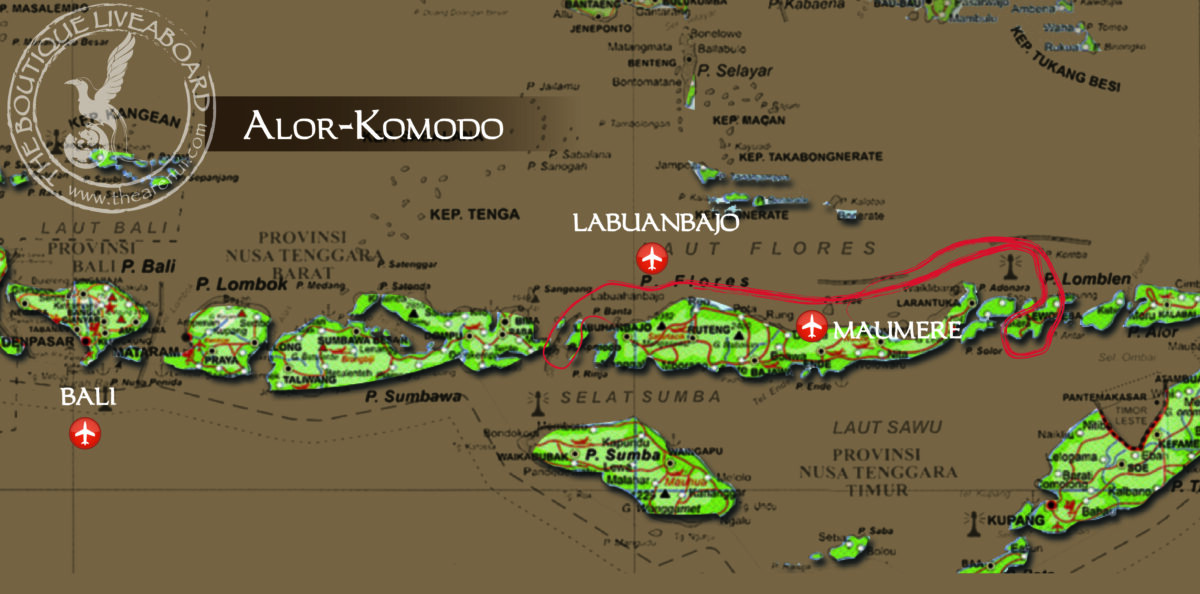
ALOR-KOMODO 02 May-13 May 2025

ALOR-KOMODO

12 Days/11 Nights Maumere- Labuanbajo ALOR-KOMODO Cruise Itinerary

Day 1 Embarkation in Maumere

Day 2 Pulau Babi (2-3 dives)

Pulau Babi

Pulau Babi literally means ‘pig island’. Its north end is bordered by a wide coral reef and faces the Flores Sea. Further south there is a small tidal flat where two villages were built. At the southern end of the island, the barrier reef tapers. It has deep walls with lots of cracks and crevices with leather corals in the shallows. Babi is home to many dive sites. One, called The Crack, was formed during an earthquake in 1992. Located in a reef 20 metres (66 ft) below the water, the 70-centimetre (28 in) crack reaches a length of 30 metres (98 ft).

Day 3 Kawula Island (4 dives)

In the south-west of Kawula Island there is a bay with world class muck diving sites.

Tanjung Waiwowan

This dive site is a mixture of reef and white sandy slope full of amazing critters. Here we have another chance to see the allusive Rhinopias camouflaged in the coral slope. This is a perfect environment for different kinds of ghost pipefish including the very rare Halemeda ghost pipefish. Wunderpus and blue ring octopus were spotted here before. During the night dive juvenile brown-banded bamboo sharks, Helmut flying gurnards and frogfish crawl around the darkened site. A full day can easily be spent here in order to discover all the wonderful creatures.

The Frog and Catfish

So named due to the number of giant frogfish and the huge school of catfish found here the first time we dived this large jetty for the local ferries. The jetty provides an excellent place for giant frogfish to laze around the concrete posts. Rhinopias, mantis shrimps, ghost pipefish, nudis and leaf fish have also been found here. Diving at this site is dependant on the local ferry schedule and permission from the authorities.

Day 4 Pura Island/Kalabahi Bay (4 dives)

Dives in the Alor/Pantar Strait promise a variety of thrills as the sites present a wide array of exciting possibilities, with topography ranging from dramatic shear drop-offs, spurs jutting out from the shore mingling together with shallow reefs where the light brings out the full colour of the dazzling corals covering all surfaces. The water temperature can be a little cooler in this area dropping from the normal 28/29 degrees Celsius (82-84 Fahrenheit) to a possible 20 Celsius (68 Fahrenheit).

Here you can see the famous Pura Island villagers splash out of their wooden dugout canoes diving underwater with homemade goggles made out of wood and the ends of glass bottles.
During the day we will also look out for large pelagics who use the Pantar Strait as a thoroughfare. If there are any sightings of whales, dolphins or even Mola Mola we may forego a dive and head out in the tenders with snorkelling gear to see if we can have a lucky encounter.

Yan Village

At Yan Village there are several wonderful spots to dive. Walls covered in sponges topped with shallow hard coral reefs where you can spot the elusive Mandarin fish to black sandy slopes where fans of macro will get their fill too. Some examples of the critters here are frogfish, weedy scorpionfish, all sorts of nudibranchs and yellow, blue and black ribbon eels.

Clown Valley

One exceptional dive site on Pura Island is probably the only place in the world where you will see this phenomenon. The entire reef is completely covered in anemones of all shapes and sizes. Enjoy a drift dive along this site and enjoy the abundant fish life, with thousands of colourful anthias and damsels dancing off the reef. Take a look at photos of Clown Valley and other wide-angle opportunities in Alor here.

Kalabahi Bay

Mucky Mosque and Rocky Church are two of the great muck dives we will do inside Kalabahi Bay on Alor Island. The ‘holy grail of fish’ Rhinopias can be found here, with a chance to see both the weedy and paddleflap scorpionfish. Ghost pipefish, soft coral crabs, frogfish, various octopus including the wunderpus and mimic, snake eels, sea moths, sand divers and many other remarkable creatures The only way you are likely to see stranger is if you do a night dive here when unimaginable ones begin foraging out of their holes.

Day 5 Bacatan (4 dives)

Next to the north of Kawula Island there is a beautiful, calm bay overlooked by Lewotolo volcano. We spend the day diving here.

Tanjung Bacatan

Tanjung Bacatan is within view of Lembata and Komba volcanoes. Tanjung means corner and the dive site is situated on a point on the north shore of Kawula island. The dive site consists of a wall covered in crevices and ledges covered in soft corals and large sponges with hard coral gardens in the shallows. At one end the wall turns into a white sandy slope hosting many varieties of reef fish and triggerfish. A resident school of barracuda can be seen here as well as turtles and maybe even large trevallies passing by.

Takat Prau

In the middle of the bay there is a seamount we call Takat Prau. There is a small wooden fishing boat wrecked in the deep right next to a sea fan with pygmies. There can be schooling fusiliers here with small reef sharks patrolling the pinnacle. Leaf fish make their home in the shallows and large reef octopus are often spotted hunting in the hard coral.

Padang Pasir

This dive site has two sections. A huge expanse of white sand extends to the south and a mini wall and reef comes out from the corner of the island. In the sandy area look for waspfish, flounders, stingrays and ghost pipefish. On the wall algae shrimp, moray eels, lionfish and beautiful angelfish hide out. At the top of the reef there are healthy staghorn corals where you might spot a mandarin fish. At night the wall and reef come alive with shrimps and crabs and there is a chance you will see Spanish dancer nudis. Or hunt around in the sand for stargazers, bobtail squid and frogfish.

Day 6 Palu’e Island (2 dives)

Palu’e is located north of Flores Island and 45 nautical miles from Maumere. It is part of the Lesser Sunda Islands and Rokatenda (Paluweh) volcano is located in the northern region of Palu’e. There is a population of almost 10,000 people in eight mountain villages. There are no roads or vehicles on the island. The volcano erupted in August 2013 and is still smoking today.

Raja River

Raja River is located on the south west of the island. It is a beautiful wall that drops from the depth of 8 metres – 24 ft to about a depth of 30 meters – 90 ft. Along this dramatic and very long wall there are overhangs and cuts with opportunities to see leaf fish, reef octopus, nudibranchs and in particular the juvenile stage of many different kinds of reef fish. We can enjoy also the beauty of the large size of tube sponges, gorgonians sea fans and the black coral bushes along the wall and the hard coral garden in the shallows of the dive site.

Day 7 North Komodo (4 dives)

Two celebrated dive sites await you, just north of Gili Lawalaut Island. Crystal Rock and Castle Rock are both incredible locations, boasting the key elements for any impressive dive site: a wide variety of healthy corals covering the reef, plus tons of fish – both big and small and all sizes in between! There are more exhilarating dives in this area, Aquarium, Coral Garden, Gili Lawalaut Lighthouse and a bit more to the northeast Batu Montjo, along with good night dives on healthy hard coral reefs off the island of Gili Lawa Darat. Between the dives there is a chance to visit Gili Lawalaut Island and take a short trek to the top of the hill for a wonderful view over the Komodo-Flores channel.

Crystal Rock

The rock jutting out of the surrounding crystal clear waters explains how this site got its name. But what is truly memorable here are the large schools of fusiliers and anthias flitting over the gorgeous soft corals and impressive table corals. In the deep blue, you can also see at times large tuna, mackerel and other fish schooling around a small mound to the northwest. A lone eagle ray is often spotted here cruising in the currents.

Castle Rock

Castle Rock is a submerged pinnacle situated a kilometre further north from Crystal Rock. Its exposed location means strong currents but experienced divers will love the thrills to be had on this dive. In fact, the main action comes from watching the staggering amount of fish such as batfish, groupers, midnight snappers and impressive schools of fusiliers and surgeons whipping past. Of course, divers aren’t the only ones interested in the huge amount of fish here, which explains the giant trevally as well as whitetips, blacktips and grey reef sharks hunting around for their next meal.

Aquarium

This beautiful shallow dive site on the southwest corner of Gili Lawalaut offers a good possibility to see manta rays passing by. Big coral formations surrounded by thousands of glassfish offer amazing wide angle photography opportunities. White tip reef sharks can be found in the sandy bottom area and hawksbill and green turtles can be seen along the calm flower coral reef.

Coral Garden

We start the dive in a white sandy area with stunning coral heads and big barrel sponges. Watch out for leaf scorpionfishes, hairy squat lobsters, morey eels and different types of stingrays. The reef converts into a beautiful hard coral wall where thousands of fusiliers and dozens of trevallies and snappers can be seen.

Batu Montjo

In the northwest of Komodo Island, Batu Montjo is a perfect site to dive as a third dive with a amazing formation of hard corals in the shallows. Many boulders covered with gorgonian sea fans lie in between the white sandy slopes. This combination of hard corals and gorgonian sea fans with all the fish swimming in between the coral garden makes for a perfect relaxing afternoon dive. Leaf fish, mantis shrimp, jaw fish and turtles are often seen at this site.

Gili Lawalaut Lighthouse

On the north of Gili Lawalaut there is a lighthouse at the end of a long reef. When the tide is going down the dive starts on the reef with a drift to the corner. At the corner there are big schools of batfish, snappers, surgeons with napoleon wrasse and reef sharks also hanging around.

Day 8 Komodo-Flores Channel (4 dives)

Currents in this area can be quite strong and we have to dive according to the tides. There are many dive sites and the sites chosen will be dependent on the currents. Finish the day with a great night dive at Wainilo. Komodo is an excellent place for spotting macro critters and the reefs and corals are spectacular too. See some photos here.

Sebayur Kecil

This island at the east side of Komodo National Park is a perfect spot to do our check-out dive as currents tend to be very mild here. We start the dive on a white sand patch were we can look out for blue spotted stingrays, garden eels and other sand inhabitants. Continuing to the east the reef gets into a beautiful hard coral wall. Leaf scorpionfishes, reef octopus and morey eels are only a few of the inhabitants of this site.

Tatawa Besar

This is a thrilling drift dive that starts off from the northwestern tip of Tatawa and continues down the western side towards 15 to 20 meters of depth. The surrounding fish life is profuse and you will see an endless field of stunning orange soft corals as you glide along. Swim past coral heads inhabited by schools of sweetlips and batfish and look out for turtles feeding on the reef. Mantas have been encountered here as well.

Batu Bolong

Underwater this rock is covered in a huge amount of soft and hard corals and full of fish life. In the shallows watch anemone fish and look out for turtles munching on the corals. Giant trevally, white tip reef sharks, snappers and emperor fish tend to congregate here. This site presents particularly good opportunities for both macro and wide-angle photography.

Wainilo

This night dive is situated off the north of Rinca Island. In the shallows, the hard coral reef is home to many different critters, including juvenile harlequin sweetlips and batfish. Away from the reef, the sandy slope is scattered with pulsing soft corals that hide demon stingers and starry night octopus. Different types of nudibranch, frogfishes, harlequin shrimps and even wheedy rhinophias have been seen here.

Day 9 Rinca Island (4 dives)

The water temperature here and in the southern dive sites over the next few days can be a little cooler dropping from the normal 28/29 degrees Celsius (82-84 Fahrenheit) to a possible 25 Celsius (77 Fahrenheit). Also due to the infinite nutrients in the water creating the amazing biodiversity in this area the visibility can sometimes be a bit greener. Neither one of these factors can spoil the amazing diving to be had in these areas.

Horseshoe Bay is in the south of Rinca Island and we spend one full day here. Here we dive the famous Cannibal Rock, one of the top ten dives sites in the world according to some diving publications. Watch dragons, wild pigs, deer and monkeys roam the beach and take a tender ride or kayak to get a closer look.

Cannibal Rock

This outstanding dive site covers a large area with sandy slopes in the north, deep mini walls in the east, a plateau full of life in the south and rocky areas in the west. The nutrient rich bay creates the most spectacular congregation of hard and soft corals in all parts of the dive site. Sponges, ascidians, sea squirts and tube anemones are abundant. A great diversity of nudibranchs can be seen here, along with frogfish, turtles, cuttlefish and other reef fish too.

Yellow Wall of Texas

As the name suggests this wall at the southern entrance to Horseshoe Bay is covered in yellow and orange soft corals. A tiny critter, the ladybug, comes in its multitudes here. Nudibranchs decorate the wall that usually has a slight current enabling you to slowly drift along and enjoy the view.

The Boulders

Inside the bay and opposite Yellow Wall of Texas there are large rocks that continue underwater to create places for large rays to rest and even sometimes nurse sharks hide in these underwater crevices. The boulders are covered in corals becoming a paradise for marine life.

Crinoid Canyon

Another wall on the opposite side of Horseshoe Bay with deep bommies covered in soft corals and huge gorgonian sea fans. Here ribbon eels and giant frogfish have been spotted along side the hundreds of crinoid which give this dive site its name.
The Boulders
Inside the bay and opposite Yellow Wall of Texas there are large rocks that continue underwater to create places for large rays to rest and even sometimes nurse sharks hide in these underwater crevices. The boulders are covered in corals becoming a paradise for marine life. The elusive Rhinopias have been found here before.

Rhino Rocks

There is a group of rocks that at low tide break the surface that we call Rhino Rocks. This is because there has before been found the elusive Rhinopias. It is a shallow dive site with a sloping reef ending at the rocks that are covered in corals of all kinds. The reef is an excellent place to look for nudibranchs, frogfish, juvenile batfish, zebra crabs, turtles and cuttlefish. This dive site also makes an excellent night dive when you should look out for Coral Catshark.

Banana Island

Another incredible dive site named by the shape of the Island, this small island is close to Nusa Kode Island, great dive site for a third dive. Banana Island has beautiful hard coral formation in the shallows and at 15mts/45ft depth we can see some boulders cover with soft corals. Giant frog fish, broad cuttle fish, reef octopus and some special nudibrachs have been seen here. Keep always looking out into the blue for schools of mobula rays, we have seen them here once in a while.

Torpedo Alley

A marvelous night dive named after the pancake sized torpedo rays that can be found here. Coconut octopus, seahorses, colorful squid and the bizarre bobbit worm all live in the black volcanic sand. A very shallow dive with a maximum depth of 10m/30ft, spend time looking for all the strange inhabitants among the rocks, soft corals and in the sand.

Day 10 Manta Alley/Pink Beach (4 dives)

Manta Alley is located on the south end of Komodo Island. After two dives looking for manta rays we head up to the middle of Komodo Island to the Pink Beach area.

Manta Alley

Manta Alley is located in Tora Langkoi Bay along the south coast of Komodo. The dive site in fact barely pierces the ocean’s surface at the end of a line of rock islets. As can be guessed from its name many manta rays are known to frequent this site and it is the most popular one in Komodo for spotting them. The area can be described as a deep gully that works as a funnel when the tide changes, causing the water to rush through at speeds of up to three to four knots with the fall and rise of the tides and up to one knot even during “slack water” periods. Watch the mantas being cleaned on the North side or enter the ‘Alley’ to see them hover effortlessly in the current.

Pink Beach

The simple topography makes this site an ideal afternoon dive. A mini wall can be found in the middle of the reef, where clouds of glassfish swarm in the cracks and crevices. An abundant amount of fish life and unusual critters make their home here, including leaf scorpionfish, crocodilefish, nudibranchs and frogfish. On one side of the wall is a sloping coral reef full of life. On the other is a sandy area with healthy staghorn corals growing and providing shelter for juvenile harlequin sweetlips and barramundi.

Loh Liang Bay

This white sand muck dive is around the corner from Pink Beach situated inside Loh Liang Bay on Komodo Island. Search for all sorts of critters here – bobtail squid, flamboyant cuttlefish, frogfish, nudibranchs, Ambon scorpion fish, cockatoo waspfish and large moray eels living in the shallow rocks.

Day 11 Walk with dragons/Middle Area (2 dives)

Takat Makassar

This is an exhilarating drift dive along the shallow flat bottom interspersed with patches of coral reef teeming with life. There are chances to see manta rays, turtles, eagle rays and white tip and black tip reef sharks.

Siaba Besar

This spot is a nice combination with a white sand area where we can find some great critters as frogfishes, ghost pipefishes, devil scorpionfishes, upside down jellyfish and a big amount of flounders. On the hard coral area watch out for big green turtles, leaf scorpionfishes and pajama cardinalfishes.

Siaba Kecil

This little island offers a beautiful drift dive with some nice overhangs where sweetlips, snappers and trevallies can be found. After the drift we finish the dive in a pretty shallow staghorn coral area with hundreds of anthias and feeding hawksbill turtles. Have a look as well into the blue, very often we see eagle rays passing by.

Batu Tengah

This dive site is located in the middle of the Komodo National Park, 12 nautical miles to the north and 12 nautical miles to the south. The translation of Batu = Rock, Tengah = Middle. With a slope to the east of the site and a coral garden to the west Batu Tangah is a beautiful site where we often get to see turtles, cuttlefish and juvenile white tip reef sharks that hide under the table corals among the hard coral garden. Napoleon wrasse and big groups of snapper swimming on the slope with all the colourful decoration of the soft coral make Batu Tengah a high quality dive site.

Loh Buaya (walk with dragons)

Your day will end with an exciting visit to Komodo National Park where you will be able to take a stroll with the famous dragon! Take a look at our Komodo Dragon photo album here. As you walk along the paths, also stay on the lookout for deer, wild boar and birds in addition to the giant lizards. After the walk we move to the middle area of Komodo National Park.

Day 12 Disembarkation in Labuanbajo

Total dives: 34-35 dives

ALOR-KOMODO 9-19 Aug 2030

KOMODO-ALOR

11 Days/10 Nights Maumere- Labuanbajo ALOR-KOMODO Cruise Itinerary

Day 1 Embarkation in Maumere

Day 2 Pulau Babi (2-3 dives)

Pulau Babi

Pulau Babi literally means ‘pig island’. Its north end is bordered by a wide coral reef and faces the Flores Sea. Further south there is a small tidal flat where two villages were built. At the southern end of the island, the barrier reef tapers. It has deep walls with lots of cracks and crevices with leather corals in the shallows. Babi is home to many dive sites. One, called The Crack, was formed during an earthquake in 1992. Located in a reef 20 metres (66 ft) below the water, the 70-centimetre (28 in) crack reaches a length of 30 metres (98 ft).

Day 3 Kawula Island (4 dives)

In the south-west of Kawula Island there is a bay with world class muck diving sites.

Tanjung Waiwowan

This dive site is a mixture of reef and white sandy slope full of amazing critters. Here we have another chance to see the allusive Rhinopias camouflaged in the coral slope. This is a perfect environment for different kinds of ghost pipefish including the very rare Halemeda ghost pipefish. Wunderpus and blue ring octopus were spotted here before. During the night dive juvenile brown-banded bamboo sharks, Helmut flying gurnards and frogfish crawl around the darkened site. A full day can easily be spent here in order to discover all the wonderful creatures.

The Frog and Catfish

So named due to the number of giant frogfish and the huge school of catfish found here the first time we dived this large jetty for the local ferries. The jetty provides an excellent place for giant frogfish to laze around the concrete posts. Rhinopias, mantis shrimps, ghost pipefish, nudis and leaf fish have also been found here. Diving at this site is dependant on the local ferry schedule and permission from the authorities.

Day 4 Visit traditional Abui tribe village/Reta Island (2 dives)

In the morning we will visit Takpala or Latevui village, both villages still living by their old Abui traditions. The villagers will perform the Lego-Lego dance wearing traditional clothing with brass anklets that make a wonderful jingling sound as they perform. Afterwards there is an opportunity to purchase handmade ikat, woven fabrics of various colours and motifs, as well as jewellery and wooden artifacts. Take a look at our photo album of these villages at Alor Abui Tribe
After the village tour we will travel out into the Alor/Pantar Strait to Reta Island where we will do two dives before traveling to Kawula Island.

Reta Island

Reta Island and has beautiful vertical walls with overhangs, undercuts and a deep plateau at 25m/75ft. It is full of hard and soft corals, barrel sponges and whip corals. At the top of the wall is a gorgeous coral garden teeming with reef fish.

Day 5 Pura Island/Kalabahi Bay (4 dives)

Dives in the Alor/Pantar Strait promise a variety of thrills as the sites present a wide array of exciting possibilities, with topography ranging from dramatic shear drop-offs, spurs jutting out from the shore mingling together with shallow reefs where the light brings out the full colour of the dazzling corals covering all surfaces. The water temperature can be a little cooler in this area dropping from the normal 28/29 degrees Celsius (82-84 Fahrenheit) to a possible 20 Celsius (68 Fahrenheit).

Here you can see the famous Pura Island villagers splash out of their wooden dugout canoes diving underwater with homemade goggles made out of wood and the ends of glass bottles.
During the day we will also look out for large pelagics who use the Pantar Strait as a thoroughfare. If there are any sightings of whales, dolphins or even Mola Mola we may forego a dive and head out in the tenders with snorkelling gear to see if we can have a lucky encounter.

Yan Village

At Yan Village there are several wonderful spots to dive. Walls covered in sponges topped with shallow hard coral reefs where you can spot the elusive Mandarin fish to black sandy slopes where fans of macro will get their fill too. Some examples of the critters here are frogfish, weedy scorpionfish, all sorts of nudibranchs and yellow, blue and black ribbon eels.

Clown Valley

One exceptional dive site on Pura Island is probably the only place in the world where you will see this phenomenon. The entire reef is completely covered in anemones of all shapes and sizes. Enjoy a drift dive along this site and enjoy the abundant fish life, with thousands of colourful anthias and damsels dancing off the reef. Take a look at photos of Clown Valley and other wide-angle opportunities in Alor here.

Kalabahi Bay

Mucky Mosque and Rocky Church are two of the great muck dives we will do inside Kalabahi Bay on Alor Island. The ‘holy grail of fish’ Rhinopias can be found here, with a chance to see both the weedy and paddleflap scorpionfish. Ghost pipefish, soft coral crabs, frogfish, various octopus including the wunderpus and mimic, snake eels, sea moths, sand divers and many other remarkable creatures The only way you are likely to see stranger is if you do a night dive here when unimaginable ones begin foraging out of their holes.

Day 6 Bacatan (4 dives)

Next to the north of Kawula Island there is a beautiful, calm bay overlooked by Lewotolo volcano. We spend the day diving here.

Tanjung Bacatan

Tanjung Bacatan is within view of Lembata and Komba volcanoes. Tanjung means corner and the dive site is situated on a point on the north shore of Kawula island. The dive site consists of a wall covered in crevices and ledges covered in soft corals and large sponges with hard coral gardens in the shallows. At one end the wall turns into a white sandy slope hosting many varieties of reef fish and triggerfish. A resident school of barracuda can be seen here as well as turtles and maybe even large trevallies passing by.

Takat Prau

In the middle of the bay there is a seamount we call Takat Prau. There is a small wooden fishing boat wrecked in the deep right next to a sea fan with pygmies. There can be schooling fusiliers here with small reef sharks patrolling the pinnacle. Leaf fish make their home in the shallows and large reef octopus are often spotted hunting in the hard coral.

Padang Pasir

This dive site has two sections. A huge expanse of white sand extends to the south and a mini wall and reef comes out from the corner of the island. In the sandy area look for waspfish, flounders, stingrays and ghost pipefish. On the wall algae shrimp, moray eels, lionfish and beautiful angelfish hide out. At the top of the reef there are healthy staghorn corals where you might spot a mandarin fish. At night the wall and reef come alive with shrimps and crabs and there is a chance you will see Spanish dancer nudis. Or hunt around in the sand for stargazers, bobtail squid and frogfish.

Day 7 North Komodo (4 dives)

Two celebrated dive sites await you, just north of Gili Lawalaut Island. Crystal Rock and Castle Rock are both incredible locations, boasting the key elements for any impressive dive site: a wide variety of healthy corals covering the reef, plus tons of fish – both big and small and all sizes in between! There are more exhilarating dives in this area, Aquarium, Coral Garden, Gili Lawalaut Lighthouse and a bit more to the northeast Batu Montjo, along with good night dives on healthy hard coral reefs off the island of Gili Lawa Darat. Between the dives there is a chance to visit Gili Lawalaut Island and take a short trek to the top of the hill for a wonderful view over the Komodo-Flores channel.

Crystal Rock

The rock jutting out of the surrounding crystal clear waters explains how this site got its name. But what is truly memorable here are the large schools of fusiliers and anthias flitting over the gorgeous soft corals and impressive table corals. In the deep blue, you can also see at times large tuna, mackerel and other fish schooling around a small mound to the northwest. A lone eagle ray is often spotted here cruising in the currents.

Castle Rock

Castle Rock is a submerged pinnacle situated a kilometre further north from Crystal Rock. Its exposed location means strong currents but experienced divers will love the thrills to be had on this dive. In fact, the main action comes from watching the staggering amount of fish such as batfish, groupers, midnight snappers and impressive schools of fusiliers and surgeons whipping past. Of course, divers aren’t the only ones interested in the huge amount of fish here, which explains the giant trevally as well as whitetips, blacktips and grey reef sharks hunting around for their next meal.

Aquarium

This beautiful shallow dive site on the southwest corner of Gili Lawalaut offers a good possibility to see manta rays passing by. Big coral formations surrounded by thousands of glassfish offer amazing wide angle photography opportunities. White tip reef sharks can be found in the sandy bottom area and hawksbill and green turtles can be seen along the calm flower coral reef.

Coral Garden

We start the dive in a white sandy area with stunning coral heads and big barrel sponges. Watch out for leaf scorpionfishes, hairy squat lobsters, morey eels and different types of stingrays. The reef converts into a beautiful hard coral wall where thousands of fusiliers and dozens of trevallies and snappers can be seen.

Batu Montjo

In the northwest of Komodo Island, Batu Montjo is a perfect site to dive as a third dive with a amazing formation of hard corals in the shallows. Many boulders covered with gorgonian sea fans lie in between the white sandy slopes. This combination of hard corals and gorgonian sea fans with all the fish swimming in between the coral garden makes for a perfect relaxing afternoon dive. Leaf fish, mantis shrimp, jaw fish and turtles are often seen at this site.

Gili Lawalaut Lighthouse

On the north of Gili Lawalaut there is a lighthouse at the end of a long reef. When the tide is going down the dive starts on the reef with a drift to the corner. At the corner there are big schools of batfish, snappers, surgeons with napoleon wrasse and reef sharks also hanging around.

Day 8 Komodo-Flores Channel (4 dives)

Currents in this area can be quite strong and we have to dive according to the tides. There are many dive sites and the sites chosen will be dependent on the currents. Finish the day with a great night dive at Wainilo. Komodo is an excellent place for spotting macro critters and the reefs and corals are spectacular too. See some photos here.

Sebayur Kecil

This island at the east side of Komodo National Park is a perfect spot to do our check-out dive as currents tend to be very mild here. We start the dive on a white sand patch were we can look out for blue spotted stingrays, garden eels and other sand inhabitants. Continuing to the east the reef gets into a beautiful hard coral wall. Leaf scorpionfishes, reef octopus and morey eels are only a few of the inhabitants of this site.

Tatawa Besar

This is a thrilling drift dive that starts off from the northwestern tip of Tatawa and continues down the western side towards 15 to 20 meters of depth. The surrounding fish life is profuse and you will see an endless field of stunning orange soft corals as you glide along. Swim past coral heads inhabited by schools of sweetlips and batfish and look out for turtles feeding on the reef. Mantas have been encountered here as well.

Batu Bolong

Underwater this rock is covered in a huge amount of soft and hard corals and full of fish life. In the shallows watch anemone fish and look out for turtles munching on the corals. Giant trevally, white tip reef sharks, snappers and emperor fish tend to congregate here. This site presents particularly good opportunities for both macro and wide-angle photography.

Wainilo

This night dive is situated off the north of Rinca Island. In the shallows, the hard coral reef is home to many different critters, including juvenile harlequin sweetlips and batfish. Away from the reef, the sandy slope is scattered with pulsing soft corals that hide demon stingers and starry night octopus. Different types of nudibranch, frogfishes, harlequin shrimps and even wheedy rhinophias have been seen here.

Day 9 Walk with dragons/Middle Area (3 dives)

Loh Buaya (walk with dragons)

Your day will begin with an exciting visit to Komodo National Park where you will be able to take a stroll with the famous dragon! Take a look at our Komodo Dragon photo album here. As you walk along the paths, also stay on the lookout for deer, wild boar and birds in addition to the giant lizards. After the walk we move to the middle area of Komodo National Park.

Takat Makassar

This is an exhilarating drift dive along the shallow flat bottom interspersed with patches of coral reef teeming with life. There are chances to see manta rays, turtles, eagle rays and white tip and black tip reef sharks.

Siaba Besar

This spot is a nice combination with a white sand area where we can find some great critters as frogfishes, ghost pipefishes, devil scorpionfishes, upside down jellyfish and a big amount of flounders. On the hard coral area watch out for big green turtles, leaf scorpionfishes and pajama cardinalfishes.

Siaba Kecil

This little island offers a beautiful drift dive with some nice overhangs where sweetlips, snappers and trevallies can be found. After the drift we finish the dive in a pretty shallow staghorn coral area with hundreds of anthias and feeding hawksbill turtles. Have a look as well into the blue, very often we see eagle rays passing by.

Batu Tengah

This dive site is located in the middle of the Komodo National Park, 12 nautical miles to the north and 12 nautical miles to the south. The translation of Batu = Rock, Tengah = Middle. With a slope to the east of the site and a coral garden to the west Batu Tangah is a beautiful site where we often get to see turtles, cuttlefish and juvenile white tip reef sharks that hide under the table corals among the hard coral garden. Napoleon wrasse and big groups of snapper swimming on the slope with all the colourful decoration of the soft coral make Batu Tengah a high quality dive site.

Day 10 Walk with dragons/Middle Area (2 dives)

Takat Makassar

This is an exhilarating drift dive along the shallow flat bottom interspersed with patches of coral reef teeming with life. There are chances to see manta rays, turtles, eagle rays and white tip and black tip reef sharks.

Siaba Besar

This spot is a nice combination with a white sand area where we can find some great critters as frogfishes, ghost pipefishes, devil scorpionfishes, upside down jellyfish and a big amount of flounders. On the hard coral area watch out for big green turtles, leaf scorpionfishes and pajama cardinalfishes.

Siaba Kecil

This little island offers a beautiful drift dive with some nice overhangs where sweetlips, snappers and trevallies can be found. After the drift we finish the dive in a pretty shallow staghorn coral area with hundreds of anthias and feeding hawksbill turtles. Have a look as well into the blue, very often we see eagle rays passing by.

Batu Tengah

This dive site is located in the middle of the Komodo National Park, 12 nautical miles to the north and 12 nautical miles to the south. The translation of Batu = Rock, Tengah = Middle. With a slope to the east of the site and a coral garden to the west Batu Tangah is a beautiful site where we often get to see turtles, cuttlefish and juvenile white tip reef sharks that hide under the table corals among the hard coral garden. Napoleon wrasse and big groups of snapper swimming on the slope with all the colourful decoration of the soft coral make Batu Tengah a high quality dive site.

Loh Buaya (walk with dragons)

Your day will end with an exciting visit to Komodo National Park where you will be able to take a stroll with the famous dragon! Take a look at our Komodo Dragon photo album here. As you walk along the paths, also stay on the lookout for deer, wild boar and birds in addition to the giant lizards. After the walk we move to the middle area of Komodo National Park.

Day 11 Disembarkation in Labuanbajo

Total dives: 28-29 dives

BEST OF BORNEO & WEST SULAWESI 19 – 30 Jun 2028

BEST OF BORNEO & WEST SULAWESI

12 Days/11 Nights Palu-Tarakan Cruise Itinerary

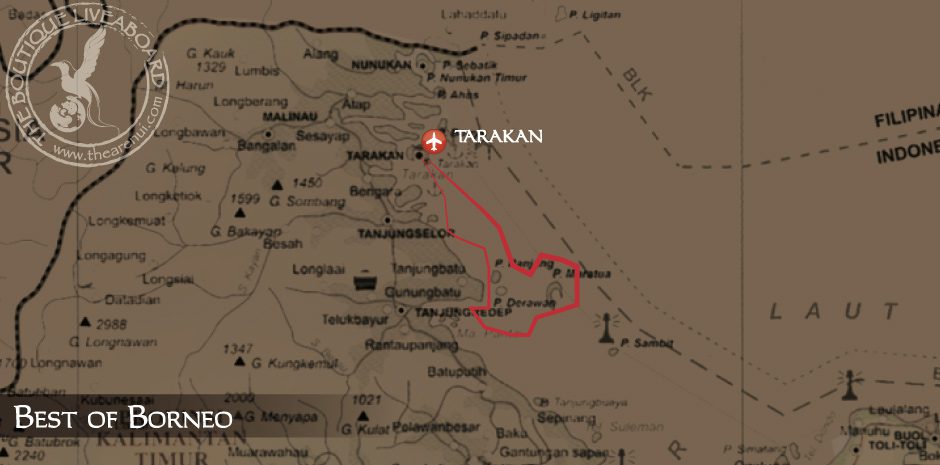
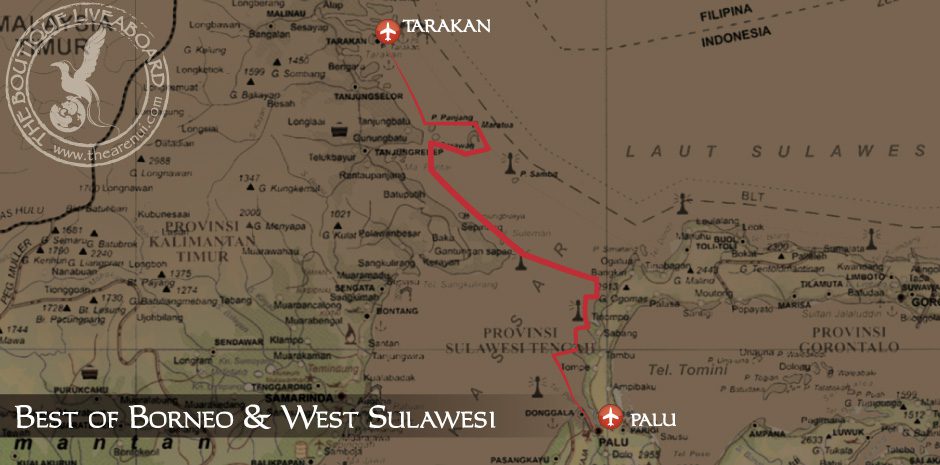
Our journey will start in Palu, Central Sulawesi and end in Tarakan, located on Tarakan Island, Borneo. Tarakan is one of the major cities in northern Borneo, close to the Malaysian border from Sabah, Malaysia. Both Palu and Tarakan are both well connected to Singapore via Balikpapan. They are also well connected to Bali and Jakarta via Balikpapan.

This 12 day, 11 night cruise takes us through the Makassar Strait from Palu to Tarakan in the Northeast of Borneo. This means we get to experience very distinct dive areas, all in one cruise. Leaving Palu, we follow the coastline to see the many picturesque islands and bays. Under the Dutch colonial government, Donggala was the main town and port in Central Sulawesi. After the main harbor was destroyed, ships needed to use the harbor in Palu, on the other side of the bay. Since then, Palu became the regional capital. We can expect to dive large reefs with immense soft and hard coral coverage, incredible pelagics, including sharks on almost each dive.

When then continue towards the Borneo coast, a number of incredible coral reefs and islands grow to the surface from the depths. Nutrient rich currents bring up big fish from the deep into shallower waters, allowing us to see them pursuing reef fish in hope of catching a meal.
Each island has its own unique character. We can see entire schools of manta rays at Sangalaki that are drawn here to feed on plankton. As well as turtles, Derawan has elusive treasures to be found; here we search for hidden critters. Maratua hosts massive marvels, such as sharks, barracudas and more mantas! At Kakaban island, plunge into the saltwater lake full with non-stinging jellyfish in the middle of the island. We will dive the incredible walls encircling the island of Kakaban. In the shallow waters around Samama, we scan for an abundance of macro critters, hiding in plain sight.

Day 1 Embarkation in Palu

Days 2/4 – Central/West Sulawesi-Palu (11 dives)

This area really is a world away from the tourist track. Liveaboards haven’t been cruising this area for long at all and so it’s unlikely we’ll see many others around. The diving here is incredible and this location’s appeal extends further than the diving; charming little fishing villages, deserted sandy beaches fringed by palm trees, surrounded by turquoise waters. Heaven on Earth.

Batu Suya

This site is a vertical drop-off with a unique coral reef formation. There are some magnificent overhangs and swim-throughs. Be on the look out for crabs and rare nudis. Be sure to explore the cracks and mini caves that are coated in colorful soft and hard corals, massive sponges, whip corals, black corals and huge gorgonian fans.. As well as some pretty cool frog fish, and crocodile fish we might even get to see a completely transparent glass perch.

Gili Raja Wreck

This wreck is a sunken cargo ship coated in black coral. The wreck is a World war 1 boat at 295ft/90m long and can be entered. Other key draws of this site are eagle rays, blue-spotted stingrays and schooling silversides. A big variety of reef fish as well as nudibranchs, shrimp, crabs, and starfish.

Anchor

Owes its name to a large anchor within the reef that is coated in beautiful coral. This long and thin reef is surrounded by large sandy areas that are interrupted by wonderous hard coral bommies coated in sponges, gorgonians, feather stars as well numerous shrimps and nudis. Be sure to peek under the table corals to see baby sharks taking a nap. Bumphead parrotfish and turtles are often seen here. Be on the look out for ghost and seaweed pipe fish.

Pasi Utara

This fantastic seamount is a great place to spot sharks. It also boasts beautiful gorgonians and soft corals as well as snappers, grunts, mackerels, rays and jack fish.

Pasi Pome

This site is a cone shaped sea mount that is circled by big schools of fish. We can be lucky to spot red, brown, and white leaf fish, nudibranchs,shoals of jack fish, batfish, snapper, surgeon fish, harlequin grunts, frog fish and pygmy seahorses. When there is some current running, we may glimpse grey reef sharks, eagle rays, and black/white tip reef sharks.

Pelabuhan Jetty

The critter diver’s choice. Under the jetty at Donggala’s Harbour we can find a variety of frogfish, seahorses, razorfish, nudibranchs, pipefish and many other treasures hidden in the sand. The seagrass here provides protection for miniature marvels.

Mutiara Wreck

This 260ft/80m long boat sank in 1954. The wreck lies on one side and the holds are now covered in soft and hard corals. This wreck can be entered and frequently here we find Longnose hawkfish, pygmy seahorses, crab and shrimps.

Enu Wall

This incredible reef lies to the side of the Bay of Palu. It descends down to 300ft/90m and is a combination of small caves, ledges and crevasses. We can find longnose hawkfish swimming along the overgrown ledges. Shoals of grunts, yellow and red pygmy seahorses are all possible here. What else? Black snappers, surgeon fish,frog fish,butterflies,napoleon wrasse, and the odd reef shark, ghost pipefish and bump heads.

Natural Reef

Natural Reef has a mix of sand and coral areas along with overhangs creating unusual topography. Here we can find napoleon wrasse, nursesharks and stingrays. As well as stonefish,lionfish, leaf fish, nudis, sweetlips and octopus hiding in holes in the reef.

Alex Point

Along a fringing reef, which is mostly flat in the shallows. It then falls steeply down to around 100ft/30m and levels out on a sandy bottom where there are plentiful bommies.One of these massive coral bommies is frequented by a station of cleaner shrimps, black snappers and harlequin grunts. Apart from invertebrates like fantastic gorgonian fans, hard corals, feather stars and slugs, there are ghost pipefish and pygmy seahorse to be found.

Green Wall

Green Wall is a vertical wall covered by hard corals and gorgonian sea fans. The reef is beautiful here and the bottom is rocky, which makes it easy for an abundant amount of different species to hide. Green Wall attracts grunts, grouper, angelfish, batfish, mackerel, moray eels, and boxfish. As well as eagle rays, sweetlips, frogfish, leaf fish,flatheads, scorpionfish, dragonets, octopu and sharks.

Days 5/6 Sangalaki (7 dives)

This area is famous for the large population of turtles and manta rays year round and guests will frequently see them feeding. The island has a turtle nursery run by the local government which can be visited. Whale sharks are frequently seen off the coast of the island.

Sandy Ridge

Macro lovers are in for a treat right here. Nudibranch, sea slug, flat worms, and other small critters galore! Butterfly fish, angel fish, and sweet lips are always resident at this site.

Turtle Town

We can expect to find…turtles! As well as unexpected surprises. Napoleon wrasse and cuttlefish. This reef is full of butterfly fish, banner fish, angel fish, surgeon fish, fusiliers, trevally, sweet lips, moorish idol, damsel fish and much more. Paradise for macro lovers too! It’s also a great spot for night dives.

Coral Garden Sangalaki

Here we dive an extremely beautiful and healthy coral reef. We can find a real variety of interesting creatures here including frog fish, crocodile fish, mandarin fish, butterfly fish, angelfish, and mantis shrimp. For those who enjoy macro, we can find tiny critters such as anemone shrimps, coral crabs and sea fan crabs.

Manta Run

Manta rays will rise up from the deeper water, and then after reaching the surface, they will circle around in order to feed on plankton. Manta rays are more often seen during the afternoon. This diving spot has a good reef, good visibility and a wide variety of reef fish.

Manta Parade

As the name suggests, we are very likely to meet a number of mantas here. It’s also a great place for snorkeling with manta ray here as they rise to the surface. Here, mantas are mostly seen from morning to noon. Coral reefs in this area are patchy and here we can find huge schools of fusiliers and surgeon fish. Various gobies and ghost pipe fish can also be found here. If we are lucky, we can also find leopard sharks here!

Eel ridge

This sandy bottomed dive site has a ‘field’ full of sand eel/ghost eel. A very different and surreal diving experience! Visibility is better during the morning to noon compared to the afternoon. We can be lucky to find lobster and mantis shrimp here too.

Manta Avenue

Manta rays can be found swimming on the surface during morning to noon. It is a shallow diving/snorkeling site, with a beautifully healthy reef. Here we swim with butterfly fish, angel fish, surgeon fish, and fusiliers. There’s also the manta beauty salon located here…a secret manta cleaning station, where mantas get cleaned by cleaner fish. The manta will swim gracefully, circling around whilst we enjoy the beautiful underwater scenery.

Day 7 – Kakaban (4 dives)

Kakaban is best known for its non-stinging jellyfish lake, located in the centre of the island, a short walk from the coast. Kakaban was likely uplifted during the Holocene and sea water was trapped turning the area and formed a landlocked marine lake. The water is now a mix of salt water and fresh water from the rain. The non-stinging jellyfish have lived in this lake for hundreds of years with no known predators. Around the coastline of Kakaban island we are offered a large variety of diving, including corals, large pelagic and caves.

Barracuda Point

This exhilarating drift dive takes us along a combination of slope and drop off. We can see abundance of butterfly fish, angels, damselfish, anthias, flatworm gobies and perhaps some sharks and the famous schooling barracuda.

Cabbage Point

This dive site gets its name from the generous amount of cabbage coral coating the seabed. Amongst scorpionfish, moray eels and batfish, we can marvel at schooling fusiliers that almost move almost as if they are one lifeform. We may also come across some blue spotted stingrays along the way.

The Corner

That’s right, it’s located on a corner of the island! As we drift around this mix of slope and steep drop-off along the north eastern coastline, we can see schooling fusiliers, blue spotted stingrays and some mean looking giant trevallies. What else? Butterfly, anthias, surgeon, scorpion, blennies, shrimp, nudis and turtles.

The Wall

Here we can hope to be mesmerized by a huge school of jacks.Leaffish, turtles, sharks, trevallies and tons of reef fish are all possible.

Land excursion: Danau Kakaban – Translates to ‘Kakaban Lake’. Using our tender boats to reach Kakban’s shore, we will take a short walk to the lake’s edge. Here we will snorkel and amongst four species of non-stinging jellyfish. They don’t sting because they have no predators within the lake. The topography is a mix of sand and vegetation with a maximum depth of just 23ft (7m). Here we can also see gobies, shrimp, crab, nudibranch and snakes.

Days 8/9 – Maratua (8 dives)

Here we have the chance to see some thrilling big creatures. Some best dives include, “The Channel” and “Big Fish” which has whirling schools of barracuda, grey reef sharks, thresher sharks, masses of turtles and schooling eagle rays schooling.

The East Wall

The two pillars at this site are the remains of a Japanese watch tower after it has been bombed during the Second World War. Here we can find a huge variety of seafans and black corals. The dive starts with a gentle slope that becomes a sharp, almost vertical drop-off. The barrel drum coral here are massive in size. This dive site is also called ‘Eagle-Ray Point’, because eagle-rays are often spotted here.

The Channel

Diving at beginning high tide when the current is flowing into the lagoon. With a considerable current, we can hook onto the reef to look out for eagle rays, barracudas, groupers and sometimes even whalesharks!

Coconut Wall

The drop off takes us along the coast drifting normally in a southeasterly direction. As well as anthias, flatworms, nudis and batfish, we can see schooling snappers and perhaps some sharks and majestic eagle rays.

Lighthouse

Here the drop-off slopes to a sandy bottom. The current here is mild and we can see a big school of batfish and sometimes leopard sharks. In the shallows we can see schools of of grouper and red snapper.

Paradise 123

Along this coral slope we can see…fusilier, sweetlips, butterfly, angel, grouper, damselfish, anthias, batfish, scorpion, blennies, shrimp, crab, nudibranch, turtles, rays and maybe black tipped reef sharks. What would be the ultimate treat to see here? To meet a thresher shark or two!

Kehedaeng

Here along this beautiful fringing coral reef we have the chance to see: Fusilier, Butterfly, Angel, Grouper, Damselfish, Anthias, Scorpion, Blennies, Shrimp, Crab, Nudibranch, Turtle and even Sharks!

Turtle Traffic

Love green sea turtles? This dive is for you! Maybe we can see up to 30 on just one dive. Here we can experience a relaxing drift dive. We also have the chance to see small groups of barracudas, jackfish and stingrays.. Being mindful to look out for critters on the reef. This location is beautiful for macro photography.

Land excursion: Goa Halo Tabung, Maratua Island – We use our tender boats to reach the southwest coast of Maratua where we hop off onto a wooden bridge. We then walk a short half mile to Goa Halo Tabunge (meaning Halo Tube Cave). We are met with beautiful, turquoise, still water which we can enter using steps on the low side of the pool and begin our swim through the cave. Sea water enters through the crevices of the cave, which is why the water here is salty.

Donning snorkeling equipment and buoys, we can enjoy an easy and relaxing float through this tunnel-like cave. Surrounded by the chirping crickets, luscious greenery and tranquil atmosphere, this is a moment to savour.

Day 10 – Derawan (4 dives)

Part of the Coral triangle, Derawan Islands have one of Indonesia’s richest and diverse ocean life. Not just diversity of Cave dives, wreck dives, muck dives, drift dives, walls, plateaux. 

Old Pier

Gets its name, from you’ve guessed it; a pier! As we follow the coral slope down and work our way south and to the east along the shoreline, we can see an abundance of butterfly fish, angels, damselfish, anthias, wrasse, gobies, shrimp and nudis. Perhaps a turtle or two and the blue spotted stingrays and schooling fusiliers are for sure the highlight.

Shark Point

As we descend the coral lope that becomes a drop off. Amongst the crabs, turtles and morays, the big attraction here is the possibility of seeing some sharks along with the impressive sight of schooling jacks.

Blue Trigger Wall

This healthy coral reef slope and wall combination is home to schooling of fusiliers and blue triggerfish. As we go along this comfortable drift, what else is there to see? Batfish, gobies, blennies, shrimp, nudibranch, turtle and shark, all have a good chance to be seen here.

Tuturuga Point

This dive site, a mix of sand and coral is impressive both by day and by night. As well as the usual suspects in this area, it is special for being home to frogfish, leaf fish, scorpionfish, flathead, Blennies, dragonet, octopus and rays.

Day 11 – Samana (3 dives)

About 15 min by boat from Sangalaki is another dive location, Samama, perfect for macro. We are likely to see pygmy seahorses and a lot of nudibranchs. The island has a large area of mangrove and the dive sites are all very shallow. Currents are very mild and so we can take some good, long dives. Sunlight filters onto the hard and soft corals illuminating them in a rainbow of color. Reef life is abundant with many schools of fish. Be on the lookout for blue ribbon eels at the edge of the reef. Minute pygmy seahorse can be found camouflaged in gorgonian seafans.

Day 12 – Disembarkation in Tarakan

Total dives: 38